
0

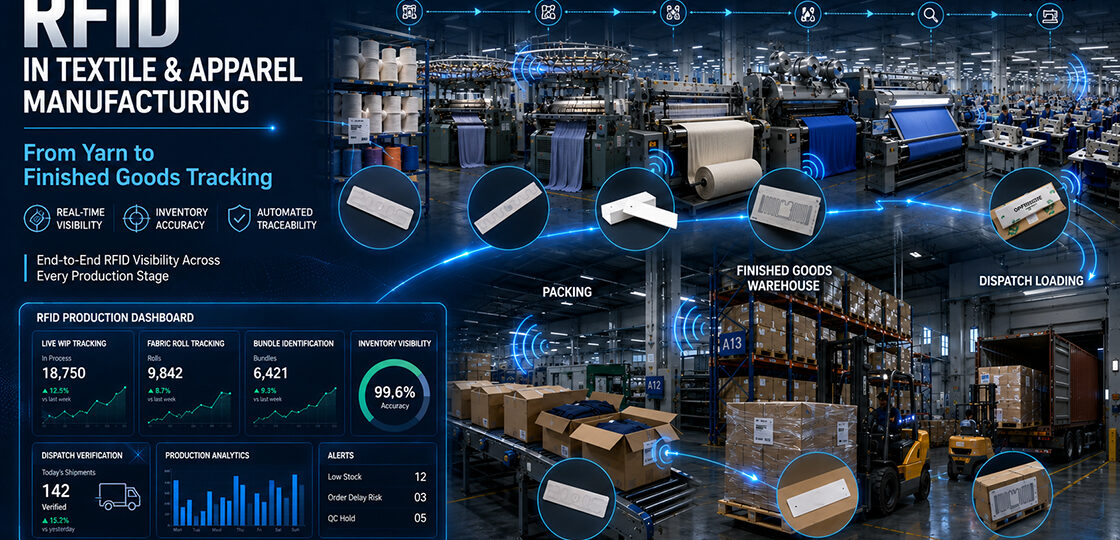
RFID in Textile & Apparel Manufacturing: From Yarn to Finished Goods Tracking
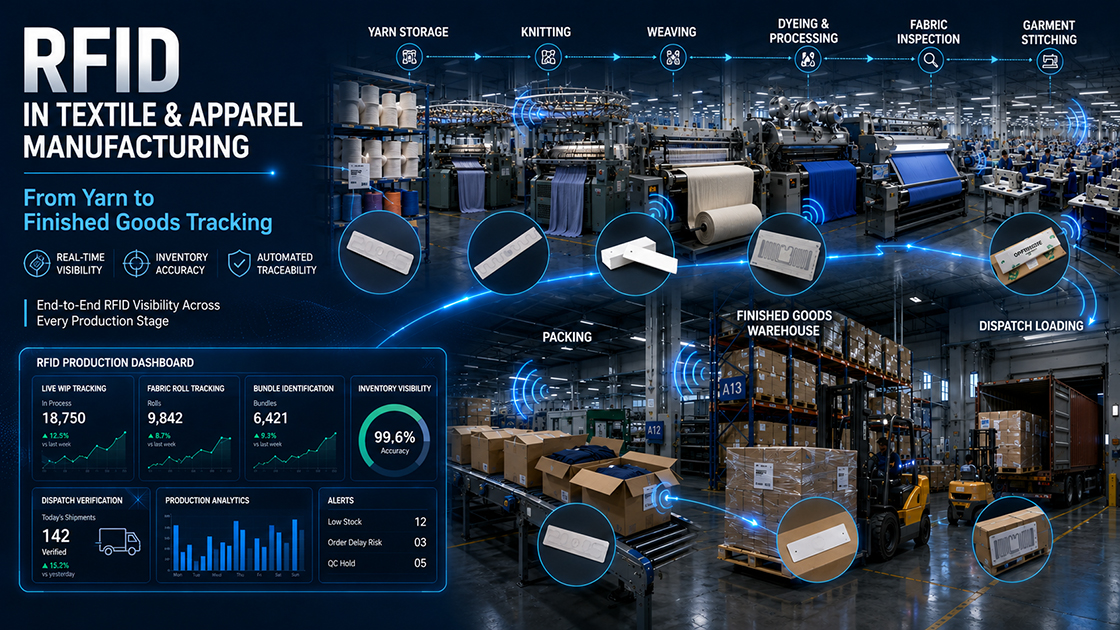
India is the world’s second-largest textile producer, with manufacturing hubs spread across Surat, Tirupur, Ludhiana, Ahmedabad, and Coimbatore. Yet most textile mills and apparel factories still rely on manual tally sheets, barcode scanning, and paper job cards to track production — methods that break down the moment production scales up, shift changes happen, or export deadlines hit simultaneously.
UHF RFID changes this. It gives textile manufacturers end-to-end visibility from the moment yarn enters the factory to the moment finished goods leave the dispatch gate — without manual intervention at every checkpoint. This guide explains where and how RFID applies across the textile production chain.
The Tracking Gap in Textile Manufacturing
A typical textile plant handles hundreds of yarn lots, fabric rolls, dye batches, cut bundles, and finished cartons simultaneously — across multiple floors, shifts, and sub-processes. Without automated identification, two problems are constant:
- Inventory mismatches: Physical stock and system records diverge within days. Re-counting is manual, slow, and still inaccurate.
- Process delays: A missing bundle, wrong yarn lot on the loom, or untracked fabric in dyeing causes cascading delays that only surface when an order is already late.
- Export compliance gaps: Buyers — especially European and US brands — increasingly require batch-level traceability. Manual records do not hold up to audit.
- Shrinkage and pilferage: Yarn and fabric are high-value, easy-to-remove items. Without automated tracking at exit points, losses go undetected until stock takes.
Barcode scanning addresses some of this, but only where a worker remembers to scan. UHF RFID automates the capture — tags are read in bulk, through cartons, without line-of-sight, as items move through read zones.
RFID Across the Textile Production Chain
Here is how RFID applies at each stage of textile manufacturing:
| Production Stage | What Gets Tagged | Tag Type |
|---|---|---|
| Raw Material Inbound | Yarn cones, fabric rolls, dye batches | RFID Label / Inlay |
| Production / Knitting | Work-in-progress bundles, trolleys | RFID Label on tag card |
| Dyeing & Processing | Fabric lots, process batches | Heat-resistant RFID Label |
| Quality Inspection | Inspected bales, rolls, cut pieces | RFID Label with grade data |
| Finished Goods Store | Cartons, SKU bundles, poly bags | RFID Smart Label |
| Dispatch / Logistics | Pallets, export cartons | RFID Label / Portal Read |
Stage-by-Stage Application Detail
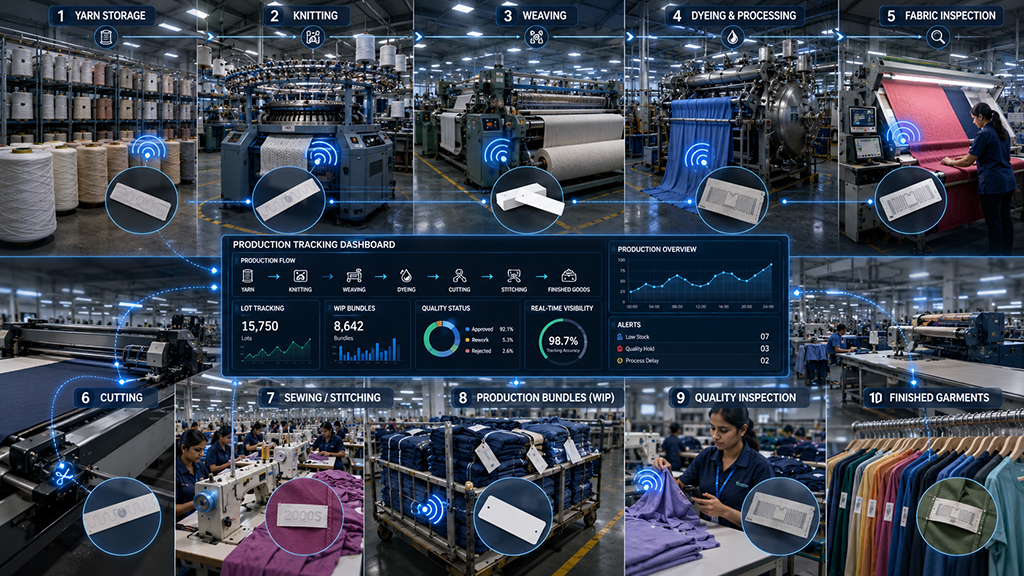
Stage 1 — Raw Material Inbound
Yarn cones, fabric rolls, and dye chemicals arrive in large volumes. RFID-tagged consignments are automatically read at the inbound gate using a Fixed RFID Reader portal — recording supplier, lot number, weight, and quantity into the ERP in seconds. No manual GRN entry, no counting errors at the dock.
Stage 2 — Production Floor / Loom / Knitting
As yarn cones are loaded to looms or knitting machines, RFID tag cards attached to each production bundle move with the WIP. At each workstation or machine handover point, a fixed reader or Handheld RFID Reader captures the bundle ID and current stage — giving supervisors a live view of how many bundles are at which stage of production at any time.
Stage 3 — Dyeing and Processing
Dyeing is where lot mixing errors cause the most damage in textile — wrong fabric lot in the wrong dye batch can ruin an entire colour run. RFID eliminates this. Each fabric lot carries an RFID Label with lot data. The dyeing machine or batch trolley is read before processing begins, and the system validates that the correct lot is loaded against the production order.
Stage 4 — Quality Inspection
After dyeing or finishing, fabric rolls and cut pieces go through quality inspection. The inspector’s RFID handheld reader scans each roll and records grade, defect code, and approved/rejected status — instantly. Approved rolls move to the finished goods store; rejected rolls are flagged and isolated without needing a separate re-tagging process.
Stage 5 — Finished Goods Warehouse
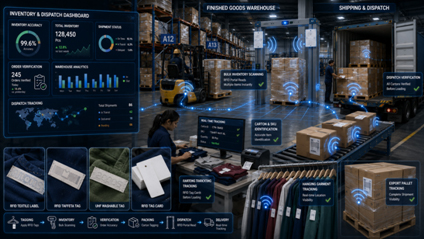
Finished garments, folded and boxed by SKU and size, are tagged at the carton level with RFID smart labels before entering the finished goods store. This enables bulk inventory counts in minutes rather than days. For large export orders, packing accuracy is verified by scanning the entire shipment through a portal reader — catching wrong sizes, missing pieces, or incorrect style codes before the container is sealed.
Stage 6 — Dispatch and Export
At the loading dock, a fixed reader portal automatically records every carton leaving the facility — building a real-time dispatch record that matches the invoice and packing list. For export shipments, this data feeds directly into compliance documentation. For domestic dispatch, it eliminates short-shipment disputes with buyers.
Choosing the Right RFID Tag for Textile Applications
Tag selection in textiles is more nuanced than in most industries because items pass through heat, moisture, chemicals, and physical stress during production.
- RFID Labels (standard): For finished cartons, packed garments, outer packaging, and logistics — standard labels perform well and are cost-effective at high volume.
- Heat-resistant RFID Labels: For fabric lots going through dyeing, calendering, or heat-setting processes — standard adhesives and inlays fail above 60°C. Specialised labels handle 150°C+ depending on the construction.
- RFID Tag Cards (woven / hang tags): For WIP bundles moving through stitching lines or knitting floors — a rigid card-format tag stays with the bundle through multiple handover points without falling off or getting damaged.
- Laundry / Washable RFID Tags: For uniform management, workwear, or hospitality textile tracking — these survive repeated industrial washing cycles and are a subset of the Morx RFID Hard Tags range.
Typical Reader and Antenna Setup for a Textile Plant
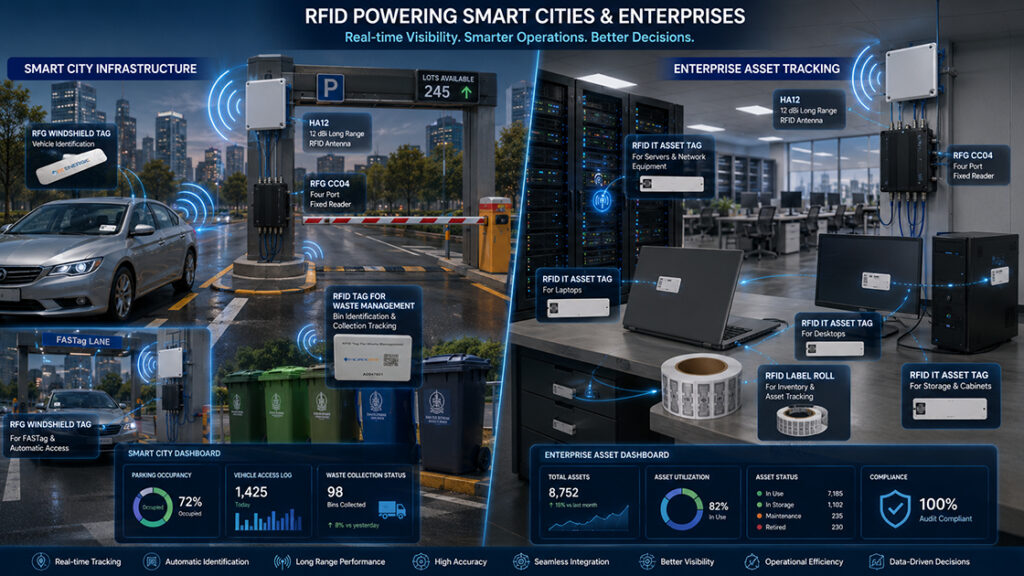
A mid-sized textile facility typically deploys RFID across the following fixed points:
- Inbound gate portal: 1–2 fixed readers with 4-antenna portal for bulk inbound capture
- Production floor: Fixed readers at department handover points (e.g., cutting to stitching, stitching to washing)
- Inspection station: Handheld readers for per-roll grade recording
- Finished goods store entry: Fixed reader portal for automatic receipt into WMS
- Dispatch dock: Fixed reader portal for outbound verification
For plants with open floor layouts, directional RFID Antennas allow zone-level read coverage without requiring items to pass through a physical portal. This works well on wide conveyor lines or open trolley movement areas.
What Textile Manufacturers Gain from RFID
- Inventory accuracy above 98% — compared to 60–75% typical with manual methods
- Production visibility in real time — supervisors see live WIP status across all stages
- Dyeing lot error elimination — wrong lot in wrong bath becomes a system-caught exception
- Dispatch accuracy for export — packing list matches actual carton content, every time
- Shrinkage reduction — fabric and yarn movement is tracked at every gate and handover
- Audit-ready batch traceability — critical for compliance with international buyer requirements
RFID in Textile vs General Manufacturing
Textile RFID shares many characteristics with broader manufacturing deployments, but with specific demands around tag durability in wet and high-heat processes. For a wider view of how RFID transforms manufacturing operations beyond textiles, see: How RFID Solutions Are Transforming Manufacturing Industry Operations.
And for a practical understanding of how RFID compares to barcode systems — which most textile plants currently rely on — the comparison guide RFID vs NFC vs Barcode for Inventory Tracking covers the technology differences, cost implications, and when each system makes sense.
Conclusion
Textile and apparel manufacturing is one of the most process-intensive industries to track — with high item volumes, multiple handover stages, and significant losses tied to lot errors, shrinkage, and dispatch inaccuracies. UHF RFID addresses all of these at every stage of the production chain, from yarn inbound to finished goods dispatch.
Morx RFID supplies the complete hardware stack for textile RFID deployments — labels, tag cards, fixed readers, handheld readers, and antennas — all built for the specific demands of production environments. Visit the Morx RFID Solutions page to explore application-specific configurations, or contact the team for a site-specific recommendation.
CategoryBlog