
0

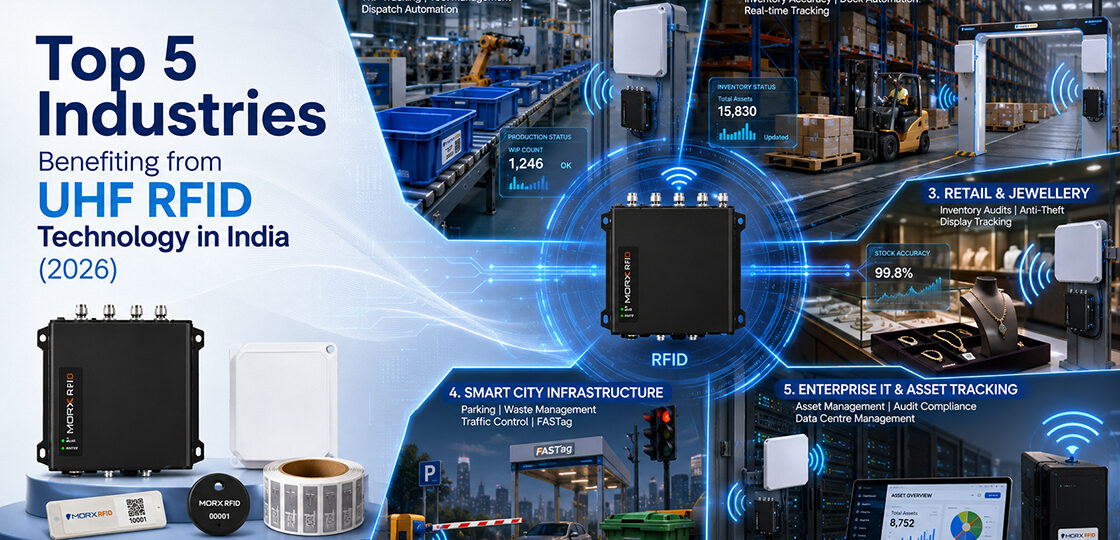
Top 5 Industries Benefiting from UHF RFID Technology in India (2026)
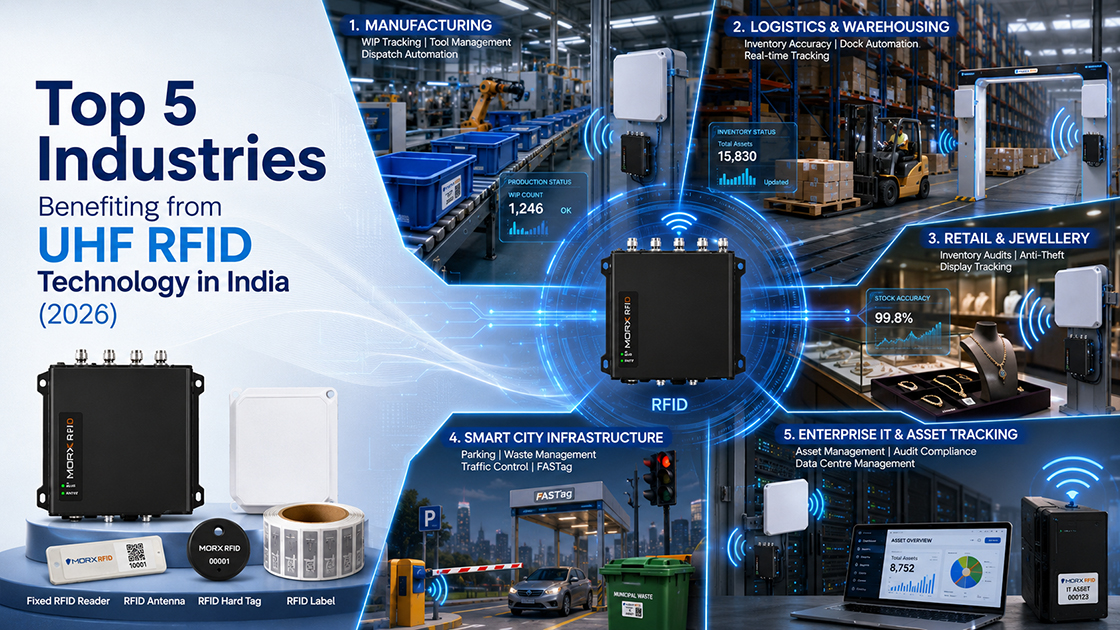
MUHF RFID adoption in India has accelerated significantly over the past three years, driven by the push for warehouse automation, smart city infrastructure, and digital supply chain transformation. From Gujarat’s manufacturing corridors to Mumbai’s logistics hubs, businesses across sectors are deploying UHF RFID systems to eliminate manual tracking, reduce operational errors, and gain real-time visibility over assets and inventory.
Here are the five industries in India where UHF RFID technology is delivering the most measurable impact in 2026.
Manufacturing — WIP Tracking, Tool Management & Dispatch Automation
Manufacturing is the single largest RFID deployment segment in India. Factories across automotive, pharmaceuticals, FMCG, and heavy engineering are using UHF RFID to track raw materials, work-in-progress (WIP) goods, finished products, returnable containers, and production tooling — all without manual scanning.
Key use cases in Indian manufacturing:
- Tagging raw material bins and pallets at inbound gates for automatic receiving
- WIP tracking across assembly lines to identify bottlenecks and stage completion
- Tool tracking to reduce loss, unauthorised use, and downtime in maintenance cycles
- Finished goods dispatch automation with portal readers at loading docks
- Returnable transport item (RTI) management for bins, crates, and racks
India’s automotive sector — including Tier 1 and Tier 2 suppliers across Pune, Chennai, and Gujarat — has been an early and heavy adopter. UHF RFID enables just-in-time inventory alignment, reduces line stoppages caused by missing parts, and provides traceability data required for quality compliance and recall management.
Industrial environments require rugged, reliable tags. RFID Hard Tags are the standard choice for machinery, metal bins, and production tooling in harsh factory conditions — rated for heat, vibration, and chemical exposure.
Manufacturing — WIP Tracking, Tool Management & Dispatch Automation
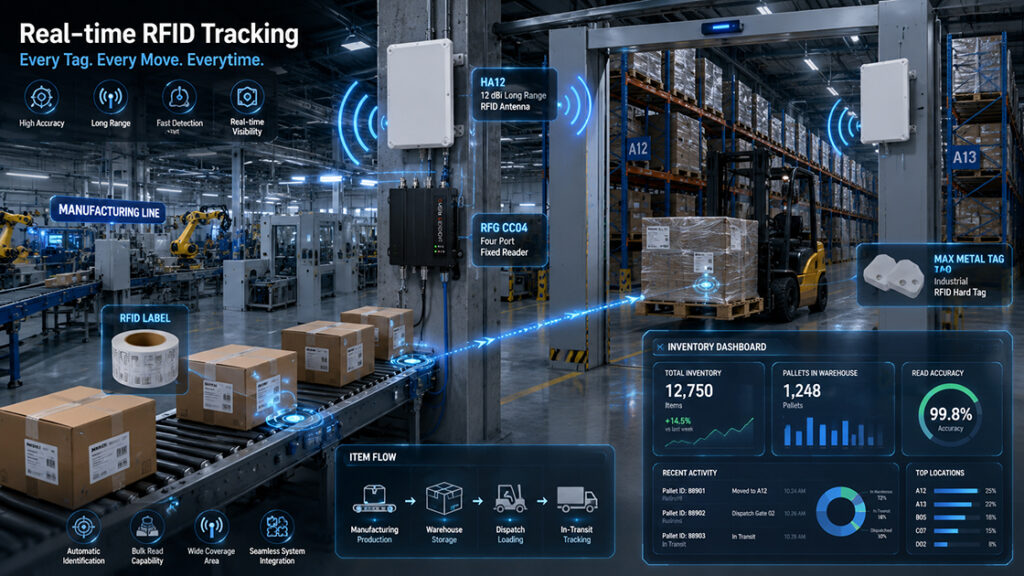
India’s logistics sector is growing at double digits, fuelled by e-commerce expansion, 3PL growth, and the GST-driven consolidation of warehousing infrastructure. With warehouses handling millions of SKUs across multiple clients, manual barcode scanning is no longer viable at scale. UHF RFID solves this at every layer of the operation.
Where Indian warehouses are deploying RFID:
- Portal readers at dock doors for automatic inbound and outbound capture
- Zone-level inventory visibility without physical counting cycles
- Pallet and carton tracking across multi-level racking systems
- Cross-docking operations with high-speed item identification
- Outbound order verification before truck loading
A key advantage of UHF RFID in warehouses is the ability to read hundreds of tagged items simultaneously as they pass through a fixed reader portal — reducing dock processing time from hours to minutes. This directly impacts throughput, labour cost, and dispatch accuracy.
Retail & Jewellery — Inventory Audits, Anti-Theft and Display Tracking
India’s organised retail sector — including fashion, lifestyle, and jewellery — is deploying UHF RFID for inventory accuracy, loss prevention, and faster store operations. The jewellery segment in particular has seen rapid RFID adoption, with showrooms tagging every SKU for instant audits, anti-theft alerts, and display tray management.
Retail RFID applications gaining traction in India:
- Item-level tagging for apparel — enabling accurate stock counts in under 15 minutes
- Jewellery showroom audits — tray-level and item-level tracking without manual counting
- Anti-theft EAS integration with RFID for high-value item loss prevention
- Smart fitting room and customer engagement systems in premium retail
- Replenishment automation — triggering stock alerts based on shelf depletion
India’s jewellery retail market — dominated by large chains in Gujarat, Maharashtra, and Tamil Nadu — has specific requirements around gold and diamond item traceability. UHF RFID provides the speed and accuracy needed for end-of-day audits, vault reconciliation, and display rotation tracking that would take hours manually.
Smart City Infrastructure — Parking, Waste Management and Traffic Control
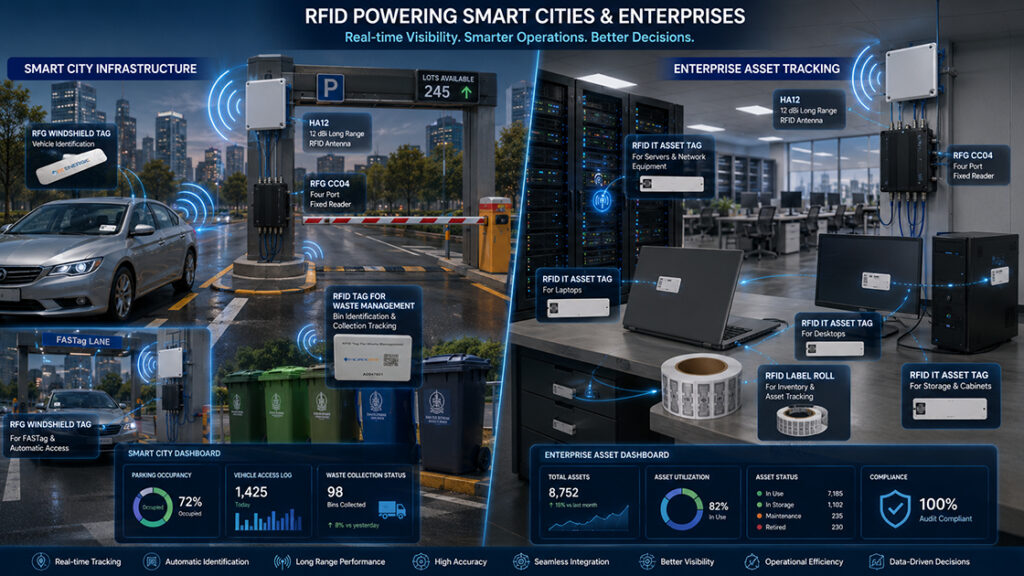
India’s Smart Cities Mission has created a large and sustained demand for RFID-based urban infrastructure. Municipal corporations, state governments, and private operators are deploying UHF RFID across three primary smart city applications: vehicle parking management, solid waste tracking, and traffic or toll automation.
Smart city RFID deployments across India:
- Residential and commercial parking systems with RFID-based vehicle authorisation and boom barrier control
- Municipal solid waste management — RFID-tagged bins tracked for collection frequency and route compliance
- Traffic management at intersections and entry/exit points in restricted zones
- FASTag and ETC tolling — the country’s largest UHF RFID deployment by volume
- School bus tracking and student attendance systems in CBSE and state board schools
India’s FASTag rollout — mandated by NHAI across all national highways — has made UHF RFID one of the most widely encountered technologies in the country. This national-scale deployment has built awareness among government procurement teams and accelerated parallel smart city projects.
The Smart Parking solution from Morx RFID is designed for residential complexes, commercial buildings, hospitals, and institutional campuses — offering complete vehicle authorisation, entry/exit logging, and boom barrier integration.
IT & Enterprise — Asset Tracking, Audit Compliance and Data Centre Management
Large enterprises, IT companies, government departments, and educational institutions are using UHF RFID to manage thousands of fixed and moveable assets — laptops, servers, projectors, lab equipment, and office furniture — with far greater accuracy than spreadsheets or barcode audits.
IT asset management use cases in India:
- Ghost asset elimination — identifying assets recorded in books but physically missing
- Annual fixed asset audits completed in hours rather than days
- Data centre rack-level server and hardware tracking
- University and school lab equipment management and accountability
- Government department asset verification for audit and compliance reporting
India’s public sector — including banks, railways, defence establishments, and state government departments — runs mandatory fixed asset audits annually. Manual barcode-based audits of thousands of assets across multiple floors are time-consuming and error-prone. RFID reduces audit time by 80% or more and improves accuracy to near 100%.
For IT and enterprise environments, thin On-Metal RFID Labels applied to laptops, servers, and metal shelves are the standard tagging solution — printable with barcodes, cost-efficient at scale, and purpose-built for metal surfaces.
Why UHF RFID Specifically — Not HF or Barcode
Across all five industries above, the common thread is UHF RFID — operating in the 860–960 MHz band. The reasons are consistent: read range of 1–10 metres for passive tags, bulk reading of 100+ tags simultaneously, no line-of-sight requirement, and compatibility with a wide range of rugged tag formats.
For a detailed comparison of RFID against NFC and barcode systems, see our earlier guide: RFID vs NFC vs Barcode for Inventory Tracking
Conclusion
Manufacturing, logistics, retail, smart city infrastructure, and enterprise IT represent the five sectors where UHF RFID investment in India is delivering clear, measurable returns in 2026. Each industry has distinct requirements — tag type, read range, environment, integration depth — but all share the same underlying need: reliable, automated identification at scale.
Morx RFID supplies the full hardware stack for deployments across all five sectors — from fixed readers and antennas to tags, controllers, and accessories. Explore the completeMorx RFID Solutions range< or contact the team for application-specific recommendations.
CategoryBlog