
0

MB100 vs MB200 Boom Barrier: Which One Should You Choose for Your Facility?
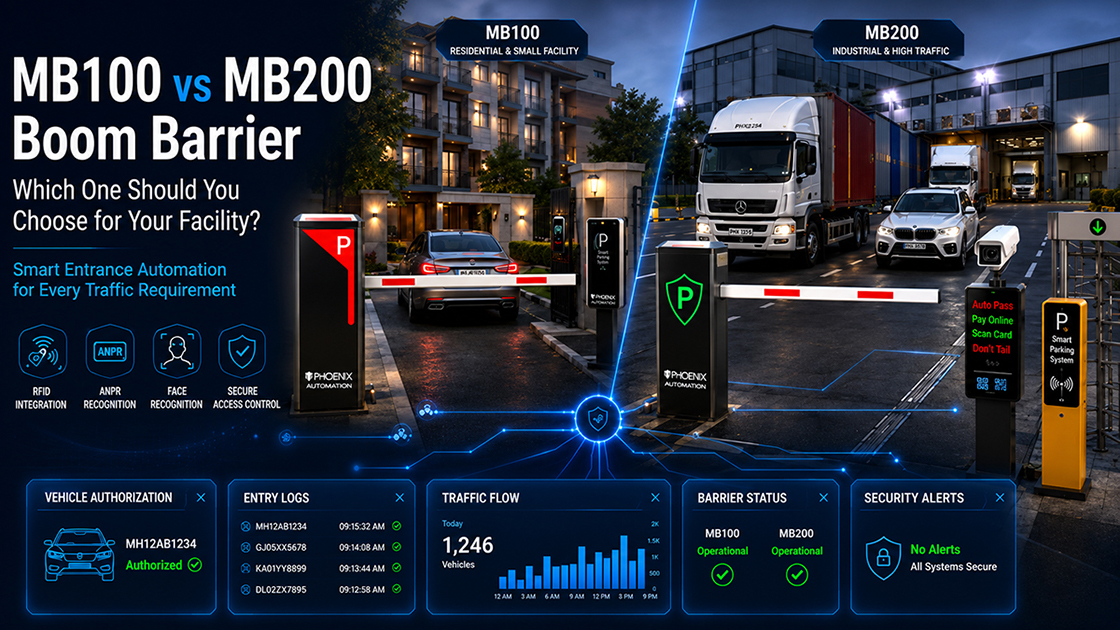
Choosing the wrong boom barrier is a mistake that shows up fast — either the gate is over-engineered for a small residential driveway, or it’s underpowered for a high-traffic industrial entrance and starts failing within months. Morx RFID offers two boom barrier models — the MB100 and the MB200 — built for different scales of entrance automation. This guide breaks down where each one fits.
What Is a Boom Barrier and Why Does the Model Matter?
A boom barrier is an automated arm-gate used to control vehicle entry and exit at a single point — parking facilities, factory gates, residential societies, and toll points. The right model depends on three factors: entrance width, expected traffic volume, and how critical uninterrupted operation is to the facility (a factory gate cannot afford downtime the way a residential society entrance can tolerate occasional manual override).
Both MB100 and MB200 fall under Morx’s Entrance Automation range, which is designed to integrate with RFID, ANPR, and biometric access control systems for fully automated vehicle authorisation.
MB100 Boom Barrier — Overview
The MB100 is positioned as Morx’s standard boom barrier for single-lane entrances — the kind of gate found at residential societies, small commercial buildings, standalone offices, and low-to-medium traffic driveways. It fits the same entrance automation ecosystem as the MB200, supporting integration with RFID tag readers or ANPR cameras for automated vehicle authorisation without a security guard needing to manually operate the arm for every vehicle.
For facilities where entrance width is standard and traffic volume is moderate, the MB100 covers the requirement without paying for the wider-span hardware built into the MB200. Detailed technical specifications for the MB100 — exact arm length, motor rating, and duty cycle — are best confirmed directly with the Morx RFID technical team for your specific site, since these vary by installation requirement.
MB200 Boom Barrier — Overview
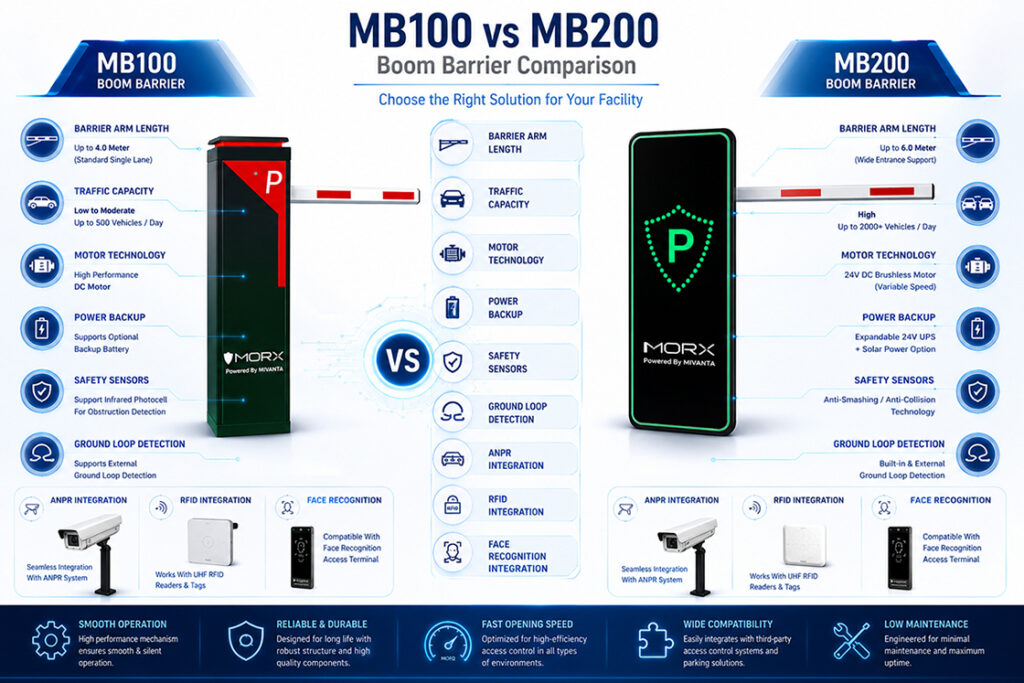
The MB200 is built for wider entrances — up to 6 metres — and higher-demand environments such as parking lots, industrial areas, and public-facing entry points. It is the more heavily specified of the two models, with several features aimed directly at high-traffic, high-reliability deployments:
- 24V DC brushless motor: Variable-speed operation for smooth, controlled arm movement and a longer mechanical service life
- Integrated one-piece movement: Frame, reducer, and transmission built as a single unit, reducing vibration and improving long-term operating accuracy
- Four-stage gear transmission: Durable, wear-resistant design backed by a 2-year maintenance warranty
- Power resilience: Expandable 24V uninterrupted power supply keeps the barrier operating through power outages, with an expandable solar power option for off-grid sites
- Anti-smashing technology: Configurable resistance detection stops the arm if it meets an obstruction, protecting vehicles and pedestrians
- Traffic guidance: Optional road gate and channel traffic light arrow guidance for directing vehicle flow at busier entrances
- Ground sensing: Supports both external and built-in ground sensing detection for automatic vehicle presence recognition
MB100 vs MB200 — Side-by-Side Comparison
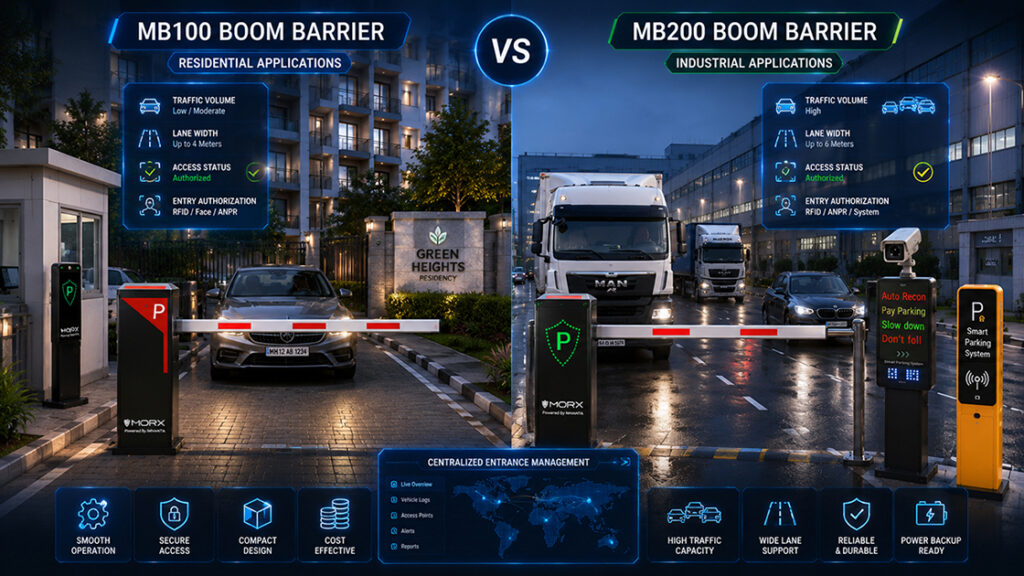
| Feature | MB100 Boom Barrier | MB200 Boom Barrier |
|---|---|---|
| Entrance Width | Standard single-lane entrances | Wide entrances up to 6 metres |
| Motor Type | Confirm with Morx team for exact spec | 24V DC brushless, variable-speed control |
| Movement Design | Confirm with Morx team for exact spec | Integrated one-piece movement, 4-stage gear transmission |
| Power Backup | Standard power supply | Expandable 24V UPS + expandable solar option |
| Safety Feature | Standard obstruction handling | Anti-smashing / anti-collision technology |
| Traffic Guidance | Not applicable | Optional road gate + traffic light arrow guidance |
| Not applicable | External and built-in ground sensing support | |
| Ideal For | Residential societies, small offices, single-lane driveways | Industrial gates, malls, campuses, high-traffic multi-lane entrances |
When to Choose the MB100
- Residential societies, gated communities, and apartment complexes with standard single-lane entry
- Small offices, shops, and standalone commercial buildings
- Low-to-medium daily vehicle volume
- Budget-conscious deployments where a full-featured industrial barrier is not required
- Facilities where occasional manual backup during power loss is acceptable
When to Choose the MB200
- Wide entrances up to 6 metres — industrial gates, factory access points, large campuses
- High-traffic facilities such as malls, corporate parks, and public parking structures
- Sites that cannot tolerate downtime — the expandable UPS and solar backup keep the gate operating through power cuts
- Locations requiring visible traffic guidance, such as multi-lane entry/exit points
- Facilities where vehicle and pedestrian safety around the barrier arm is a priority — the anti-smashing function is built in
Pairing Boom Barriers with RFID and ANPR for Full Automation
Neither the MB100 nor the MB200 identifies a vehicle on its own — the barrier is the physical control point, while an RFID reader or ANPR camera system handles vehicle authorisation. A tagged vehicle is read automatically as it approaches, the system verifies authorisation, and the barrier opens without manual intervention — this combination is the standard setup for Smart Parking deployments and society or campus access control across India.
For facilities managing both vehicle and pedestrian flow, a boom barrier is often paired with a Tripod Turnstile at the pedestrian entry point, keeping vehicle and foot traffic separately controlled.
Conclusion
The MB100 and MB200 solve the same core problem — controlled, automated vehicle entry — at two different scales. Choose the MB100 for standard single-lane entrances with moderate traffic, and the MB200 where entrance width, traffic volume, or uptime requirements call for a more heavily specified barrier.
Explore the complete Entrance Automation range at Morx RFID, or visit the Solutions page to see how boom barriers integrate into full access control deployments. For a site-specific recommendation — including exact arm length and load requirements — contact the Morx RFID team directly.
CategoryBlog