
0

What Is Entrance Automation? A Complete Guide to Smart Vehicle Access Control
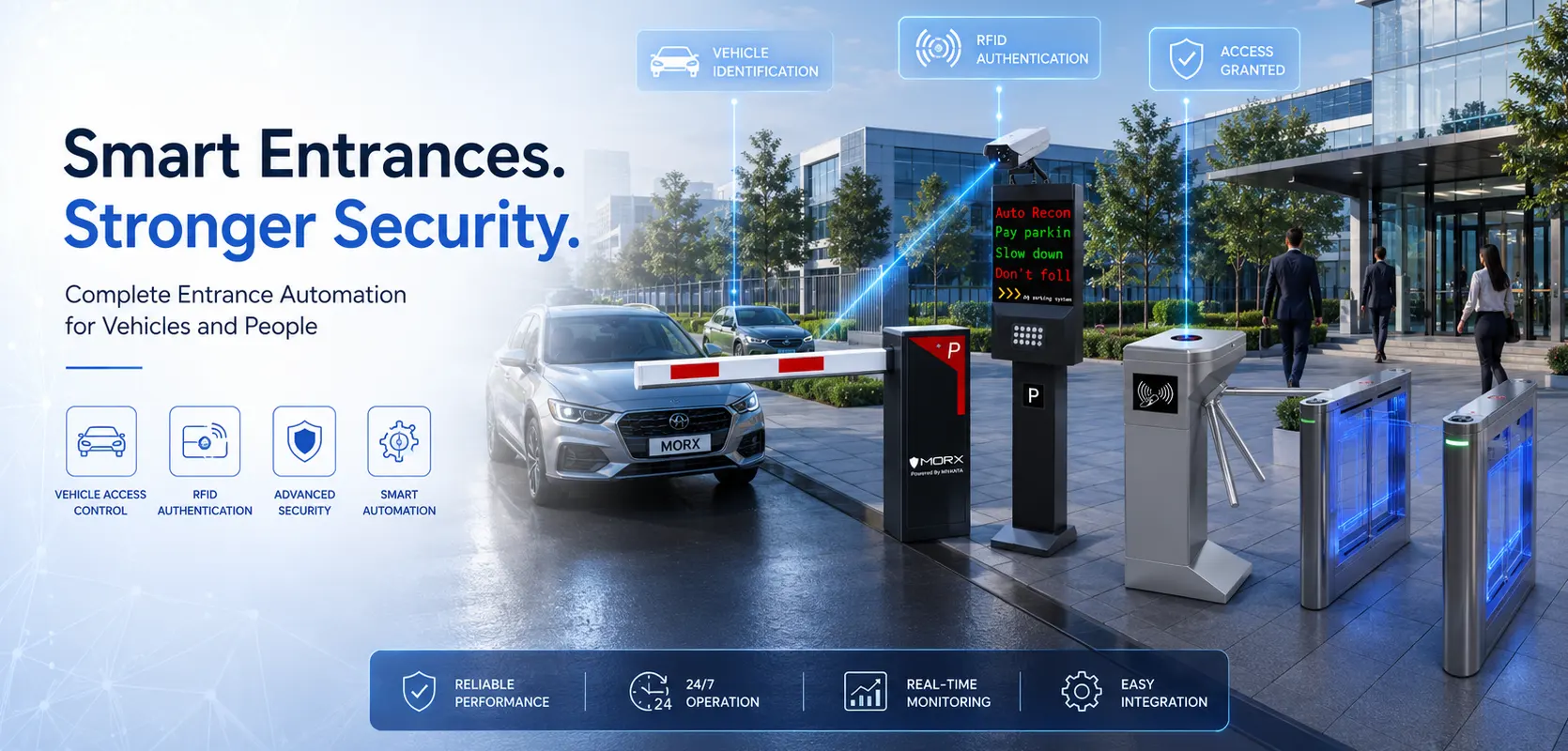
Every facility with a gate has the same underlying question: who is allowed in, and how do you let them through without a guard manually checking every vehicle? Entrance automation is the answer — a combination of hardware and identification technology that controls vehicle and pedestrian entry without constant manual intervention. This guide explains how it works, what components make up a system, and how to think about choosing one.
What Is Entrance Automation?
Entrance automation refers to systems that control physical access — for vehicles or people — at an entry or exit point, using automated hardware like boom barriers, turnstiles, and flap barriers, combined with an identification method such as RFID, ANPR (Automatic Number Plate Recognition), or biometrics. Instead of a security guard manually verifying and waving vehicles through, the system verifies authorisation automatically and opens the physical barrier only for approved vehicles or individuals.
The goal is to remove two things: manual bottlenecks at high-traffic entry points, and the security gaps that come with manual, human-dependent checks. A well-designed entrance automation system handles both vehicle gates and pedestrian entry points, and typically integrates with a facility’s broader access control and security infrastructure.
How Entrance Automation Actually Works
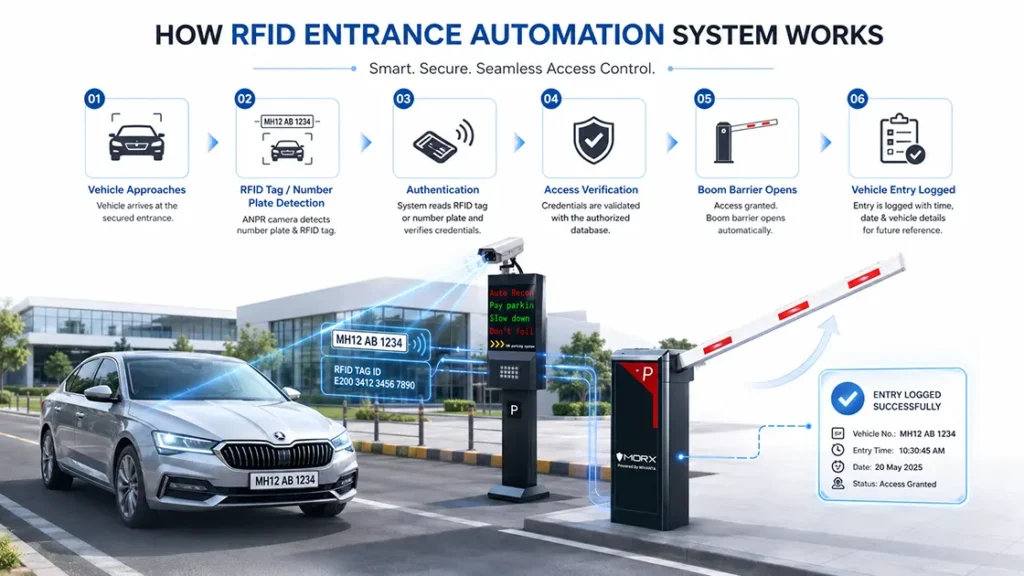
Every automated entrance system, regardless of the specific hardware, follows the same three-step logic:
- Identification: A vehicle or person is identified — via an RFID tag read at a distance, an ANPR camera reading the number plate, or a biometric/card credential at a reader.
- Authorisation check: The system checks the identified credential against its database — is this vehicle or person on the approved list for this entry point, at this time?
- Physical access: If authorised, the barrier — boom barrier, turnstile, or flap barrier — opens automatically. If not, access is denied and the attempt is logged.
This is the same underlying logic used in Morx RFID’s Smart Parking Solutions, where RFID vehicle tags are read at the gate, verified against the parking control software, and used to trigger a boom barrier — all without the vehicle needing to stop for a manual check.
The Core Components of an Entrance Automation System
1. Boom Barriers
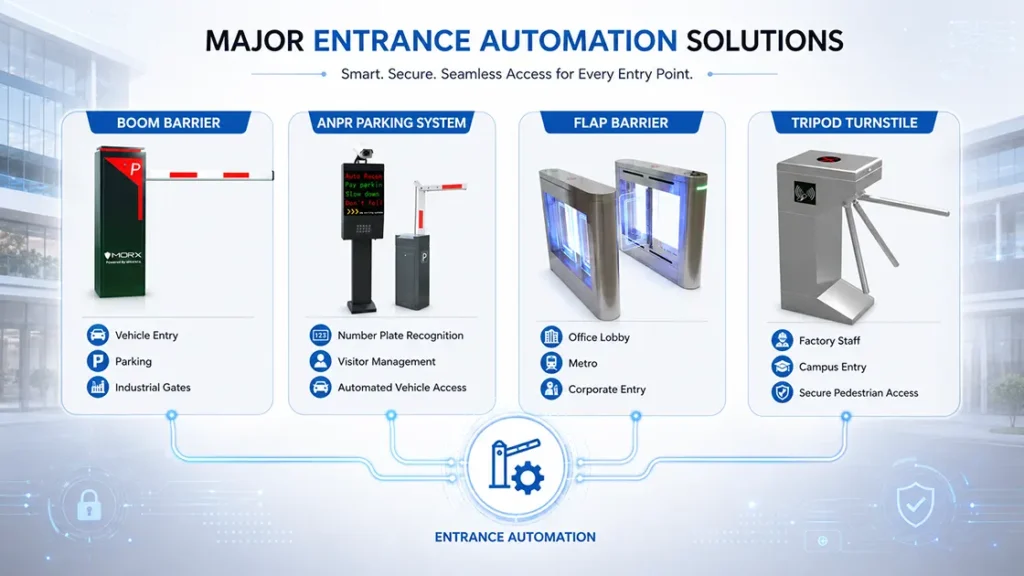
The most common vehicle access control hardware — an arm that raises or lowers to allow or block vehicle passage. Morx offers the MB100 and MB200 Boom Barriers, suited to different entrance widths and traffic volumes, from standard residential driveways to wide industrial gates handling continuous high-volume traffic.
2. ANPR Systems
Automatic Number Plate Recognition uses cameras to read and log vehicle number plates without requiring the vehicle to carry any tag or credential. This is useful where issuing physical RFID tags to every visitor vehicle isn’t practical — such as public parking or visitor management at commercial buildings. Morx’s ANPR Parking Control System is built for exactly this use case.
3. RFID Vehicle Tags and Readers
For facilities with a known, recurring set of vehicles — residential societies, corporate campuses, factories — RFID tags mounted on the windscreen are read automatically as the vehicle approaches, without needing to stop. This is faster than ANPR at high traffic volumes and doesn’t depend on plate visibility or camera lighting conditions.
4. Flap Barriers and Tripod Turnstiles
For pedestrian entry points — office lobbies, factory staff entrances, metro-style access — flap barriers and turnstiles apply the same automated logic at a smaller physical scale, opening only when a valid credential (card, biometric, or RFID) is presented.
Entrance Automation Technologies at a Glance
| System Type | Best For | Key Function |
|---|---|---|
| Boom Barrier | Vehicle entry/exit at gates, parking lots, campuses | Physical arm control, opens on authorised RFID/ANPR read |
| ANPR System | Vehicle identification without tags | Camera-based number plate recognition and logging |
| RFID Vehicle Tags + Readers | High-speed, hands-free vehicle authorisation | Tag read at distance, no vehicle stop required |
| Flap Barrier | Pedestrian entry in offices, metro stations | Controlled single-file pedestrian passage |
| Tripod Turnstile | Staff entry, campuses, factories | Physical rotating barrier tied to credential check |
Why Facilities Are Moving to Automated Entrance Systems
- Eliminates manual bottlenecks: High-traffic gates stop depending on how fast a guard can check and wave vehicles through
- Removes human error and inconsistency: Every entry decision follows the same rule set — no favouritism, no missed checks during shift changes
- Creates a complete access log: Every entry and exit is timestamped and recorded, useful for security audits and incident investigation
- Reduces staffing dependency: Fewer personnel needed at each entry point, especially valuable for 24/7 facilities
- Improves traffic flow: RFID and ANPR-based systems process vehicles in seconds rather than the delays of manual checks
How to Choose the Right Entrance Automation Setup
The right combination depends on three factors specific to your facility:
- Traffic volume and type: A residential society with predictable resident vehicles suits RFID tags; a public parking facility with constantly changing visitor vehicles suits ANPR
- Entrance width and vehicle speed: Wider industrial gates and higher-speed approach zones need different boom barrier specifications than a standard single-lane driveway
- Vehicle vs pedestrian mix: Facilities managing both need separate automation — a boom barrier for vehicles and a turnstile or flap barrier for foot traffic — rather than trying to control both through one system
Many deployments combine more than one technology — RFID for regular vehicles, ANPR as a backup or for visitor traffic, and a Fixed RFID Reader setup that reads tags at distance without requiring the vehicle to slow down significantly.
Entrance Automation Beyond Parking Gates
While parking and building access are the most visible use cases, the same underlying technology extends to broader infrastructure. RFID-based vehicle identification is the foundation of intelligent traffic management systems at intersections and toll points, and the same read-and-authorise logic scales from a single residential gate up to national highway toll infrastructure.
Frequently Asked Questions
What is the difference between RFID and ANPR for vehicle access control?
RFID requires a tag mounted on the vehicle, which is read automatically as it approaches — fast and reliable regardless of lighting or plate condition. ANPR uses cameras to read the number plate directly, with no tag needed, but depends on plate visibility and camera positioning. RFID suits known, recurring vehicles; ANPR suits visitor or public traffic where issuing tags isn’t practical.
Can entrance automation systems work during a power outage?
This depends on the specific hardware. Boom barriers like the MB200 support expandable UPS and solar backup options specifically to keep operating through power cuts — an important consideration for facilities that can’t tolerate downtime at the gate.
Is entrance automation only for large facilities?
No. Entrance automation scales from a single residential society gate with one boom barrier to multi-lane industrial facilities with barriers, ANPR, and RFID readers across several entry points. The hardware and complexity scale with the facility’s traffic and security requirements.
Do I need both a boom barrier and RFID readers?
Yes, typically. The boom barrier is the physical access control point, while RFID (or ANPR) is the identification layer that decides whether the barrier should open. Neither works as a complete automated system on its own.
Conclusion
Entrance automation isn’t a single product — it’s a system built from identification technology (RFID or ANPR) and physical access hardware (boom barriers, turnstiles, flap barriers) working together. The right combination depends on your traffic volume, vehicle predictability, and entrance layout.
Explore the complete Entrance Automation range at Morx RFID, or visit our Solutions page to see how vehicle access control integrates into smart parking, traffic management, and campus security deployments. Contact the Morx RFID team for a system recommendation specific to your site.
CategoryBlog