
0


Tamper-Proof RFID Tags: Why They Matter for Secure Vehicle Access
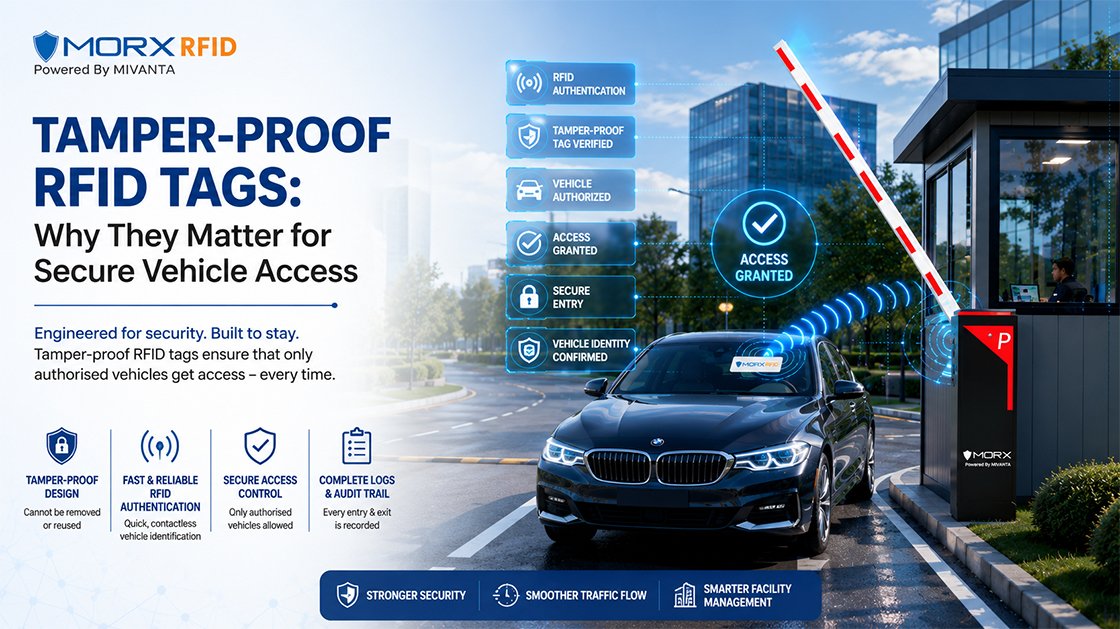
A vehicle access control system is only as secure as its weakest link — and in most RFID-based gate systems, that weak link is the tag itself. If an RFID windshield tag can be peeled off one car and stuck onto another, the entire access control logic behind it stops meaning anything. Tamper-proof RFID tags close this exact gap, and they’re the reason serious vehicle access deployments don’t rely on standard adhesive tags.
What Is a Tamper-Proof RFID Tag?
A tamper-proof RFID tag is a windshield-mounted vehicle tag engineered so that it cannot be removed and reapplied to another vehicle without being destroyed in the process. Standard RFID stickers use simple adhesive that can often be peeled off intact — which means the tag, and the access rights tied to it, can be physically transferred to an unauthorised vehicle. A tamper-proof tag breaks this transferability by design.
Morx RFID’s RFID Labels range includes two windshield tag options built specifically to prevent this kind of security bypass — the RFG-Tamper Proof Tag and the Windshield Tag, both designed to be tamper-evident from every side.
The Security Gap Standard RFID Tags Leave Open
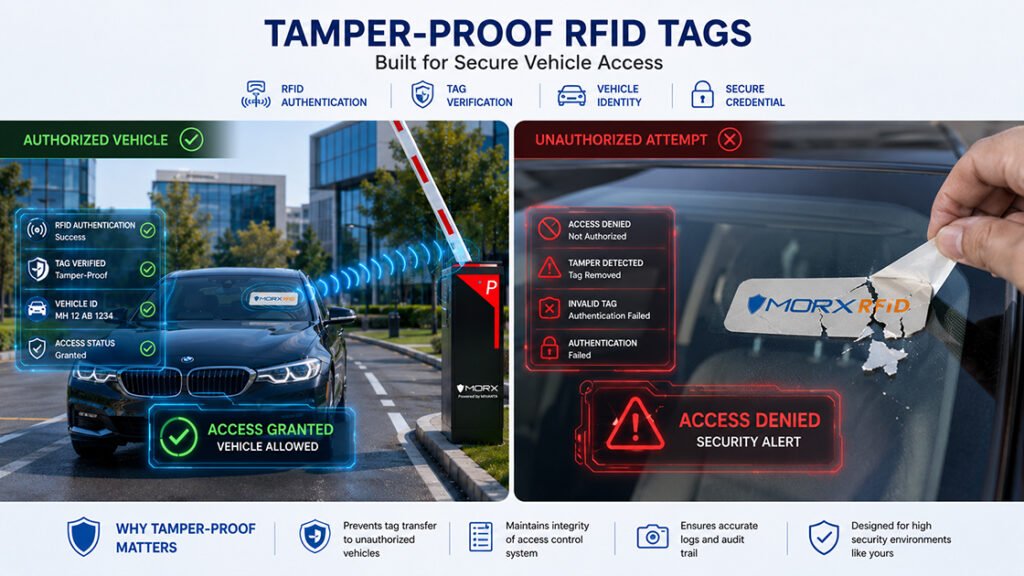
Vehicle access systems work on a simple assumption: the tag identifies the vehicle, and the vehicle it’s attached to is the one authorised. That assumption only holds if the tag physically cannot move between vehicles. With a standard adhesive tag, it can — and this creates a specific, exploitable gap:
- Tag transfer between vehicles: An authorised resident’s tag is peeled off and moved to an unauthorised or visitor vehicle, granting it the same access
- Resale or handover risk: When a vehicle is sold, a removable tag can travel with the owner to a new, unregistered vehicle instead of being deactivated
- Undetected access breaches: Without tamper evidence, security staff have no visual indication that a tag has been moved or reused
- Weakened audit trail: If tag identity and vehicle identity can drift apart, the entry/exit logs the system generates become unreliable
For low-stakes environments — a small office parking lot, for example — this risk may be acceptable. For gated residential communities, corporate campuses, industrial facilities, and toll infrastructure, it isn’t. This is exactly where tamper-proof construction becomes a requirement rather than a nice-to-have.
How Tamper-Proof Construction Actually Works
The tamper resistance in a windshield RFID tag comes from physical construction, not software. Morx’s RFG-Tamper Proof Tag illustrates the approach: the tag is built on an Impinj RAIN RFID chipset, embedded between three thick layers of PET material, with the tag ID printed directly onto the tag’s adhesive layer.
- Knife-line antenna design: The antenna is structured so that any attempt to peel the tag off cuts through the antenna circuit itself, permanently disabling it
- Multi-layer PET construction: The chip and antenna are sealed between layers that resist splitting cleanly — an attempted removal damages the tag rather than lifting it whole
- Adhesive-printed Tag ID: Because the ID is part of the adhesive layer, any tampering visibly disrupts the printed identifier, making reuse or misrepresentation obvious
The result is a tag that is functionally single-use per vehicle — once removed, it stops working, rather than continuing to broadcast a valid credential from wherever it’s re-applied.
RFG-Tamper Proof Tag vs Windshield Tag
| Detail | RFG-Tamper Proof Tag | Windshield Tag |
|---|---|---|
| Construction | 3 layers of thick PET material, Impinj RAIN RFID chipset | Windshield-mount construction, tamper evident from all sides |
| Antenna Design | Knife-line antenna design for full-side tamper protection | Standard windshield tag antenna layout |
| Tag ID | Printed directly on the tag adhesive | Encoded per vehicle for authorisation tracking |
| Core Use Cases | Vehicle tracking, gate automation, residential societies, parking lots, toll plaza | Toll plaza, residential society, malls, hotels |
Where Tamper-Proof Tags Matter Most
Residential Societies and Gated Communities
Resident vehicle tags are tied to specific units and specific approved vehicles. A tamper-proof tag ensures that access granted to one resident’s car can’t quietly extend to a second vehicle, a tenant’s car after move-out, or a visitor vehicle borrowing the tag for the day.
Corporate Campuses and Industrial Facilities
Employee and contractor vehicle access needs to match exactly who is authorised to be on-site. Tamper-proof tags keep that authorisation list accurate — a departing employee’s tag can’t be handed off informally to someone still working there.
Toll Plazas and FASTag-Style Systems
At toll infrastructure, tag-to-vehicle integrity is a financial and compliance matter, not just a security one — a transferable tag creates billing disputes and fraud exposure. This is why tamper-evident construction is standard practice in FASTag and ETC tolling systems at national scale.
Malls, Hotels, and Commercial Parking
High-turnover parking facilities — malls, hotels, event venues — use windshield tags for subscription or frequent-visitor parking. Tamper resistance prevents a paid or authorised tag from being shared informally across multiple vehicles.
Deploying Tamper-Proof Tags as Part of a Complete System
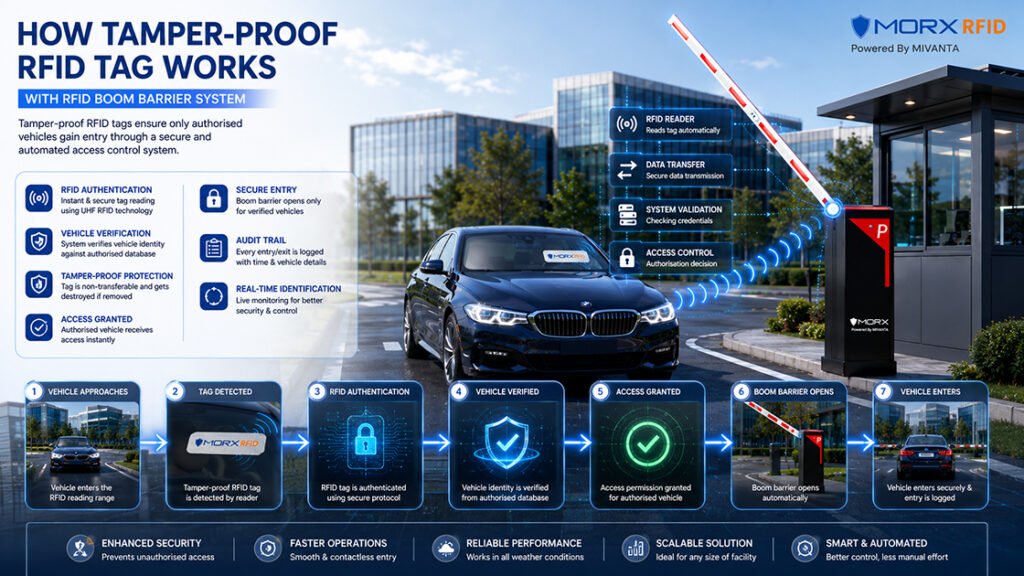
A tamper-proof tag solves the identity-integrity problem, but it’s still one component of a working vehicle access system. It needs to be paired with the hardware that reads and acts on it:
- Fixed RFID Readers: Installed at gates to read the tag automatically as vehicles approach, without requiring the vehicle to stop
- Entrance Automation hardware: Boom barriers and gate systems that physically open or deny access based on the tag read result
- Parking or access control software: The system that maintains the authorised vehicle list against which each tag is checked
Tamper-proof tags pair directly with Fixed RFID Readers and the wider Entrance Automation range — boom barriers and gate systems — in setups like Morx’s Smart Parking Solutions, where the three-step read-authorise-open logic depends entirely on the tag reliably identifying one specific vehicle.
Frequently Asked Questions
What happens if someone tries to remove a tamper-proof RFID tag?
The tag is designed to be damaged in the process. The knife-line antenna design and multi-layer PET construction mean peeling the tag off breaks the internal antenna circuit or visibly disrupts the printed ID, rendering the tag non-functional rather than allowing clean removal and reuse.
Can a tamper-proof tag be reused if a vehicle is sold?
No — that’s the intended behaviour. When a vehicle changes ownership, the tag should be deactivated in the system and a new tag issued to the new vehicle. Tamper-proof construction prevents the old tag from simply being moved to a different car and continuing to work.
Is a tamper-proof tag the same as a tamper-evident tag?
Both terms describe tags designed to resist unauthorised removal and reuse, with the goal of either preventing reuse entirely or making tampering visibly obvious. Morx offers both the RFG-Tamper Proof Tag and the Windshield Tag, each built to prevent a removed tag from being used on another vehicle.
Do tamper-proof tags cost significantly more than standard RFID tags?
There is typically a modest cost premium due to the additional material layers and antenna design, but for facilities managing vehicle-level security — residential societies, campuses, toll systems — this is a small cost relative to the security gap a transferable tag creates.
Conclusion
Vehicle access control is only as reliable as the tag-to-vehicle relationship it depends on. Standard adhesive RFID tags leave that relationship easy to break; tamper-proof construction — multi-layer PET, knife-line antenna design, adhesive-printed IDs — closes it by making removal destructive rather than clean.
Explore the RFG-Tamper Proof Tag and Windshield Tag from Morx RFID, or browse the complete RFID Labels range to find the right tag for your vehicle access deployment. Contact the Morx RFID team for a site-specific recommendation.
CategoryBlog