
0

Local vs Imported vs Professionally Supported Boom Barriers: What Buyers Should Know
Every boom barrier looks roughly the same in a product photo — an arm, a motor housing, a control box. What actually determines whether that barrier is still working reliably two years from now has almost nothing to do with the photo, and everything to do with where and how it was sourced. Buyers typically choose between three routes: a locally fabricated barrier, a directly imported unit, or a professionally supported barrier backed by a local supplier. Each comes with a very different cost and risk profile — this guide breaks down what to actually expect from each.
Why Sourcing Route Matters More Than the Barrier Itself
A boom barrier is a mechanical device with a motor, gearbox, and control electronics that will need servicing, spare parts, and eventually replacement components over its working life. The barrier’s price tag reflects the hardware. What it doesn’t reflect is whether you’ll be able to get a replacement gearbox in six months, whether the warranty actually means anything when you call about it, or whether the unit was even built for Indian power standards in the first place. That’s the real difference between the three sourcing routes.
Option 1 — Local / Unbranded Fabricated Barriers
These are barriers built by local welders, fabricators, or small workshops — often to a rough visual spec rather than an engineered design. They’re common at the very low end of the market, especially for budget-constrained residential gates.
Advantages
- Lowest upfront cost, often significantly cheaper than branded alternatives
- Fast turnaround since there’s no import or shipping lead time
- Easy to request custom dimensions from a local fabricator
Risks
- No standardised build quality — performance varies significantly between units, even from the same fabricator
- Warranty is rare, and when offered, is usually informal and unenforceable
- Motor and gearbox components are often generic or repurposed, with no engineered duty cycle rating
- No documented specifications — buyers often don’t know the actual motor rating, arm load capacity, or expected service life
- Safety features like anti-smashing or obstruction detection are frequently absent entirely
Option 2 — Directly Imported Barriers
This route involves importing a boom barrier directly from an overseas manufacturer — often to access a specific brand, feature set, or price point not available locally. It’s more common among buyers with existing import relationships or system integrators sourcing at scale.
Advantages
- Access to established overseas brands and factory-standard build quality
- Consistent manufacturing — the same model performs the same way across units
- Often includes a manufacturer’s datasheet and documented specifications
Risks
- Warranty claims typically require shipping the unit back overseas or dealing with a manufacturer who has no local presence — in practice, this often means the warranty is largely theoretical
- Spare parts have to be re-imported for every failure, adding weeks of downtime and customs handling
- Support is in a different time zone and often a different language, slowing down troubleshooting
- Power specifications may not match Indian 220V/50Hz standards without additional conversion hardware
Import duties, GST, and customs clearance add real cost and delay that isn’t visible in the sticker price
Option 3 — Professionally Supported Barriers
This route means buying through a supplier with an established local presence — someone who stocks the hardware, honours the warranty without a re-import process, and provides pre-sales and post-deployment technical support from within the country. This is where Morx RFID’s MB100 and MB200 Boom Barriers fit — part of a PAN India distribution and support network built specifically to close the gaps left by the first two routes.
Advantages
- Warranty claims are handled locally, without shipping hardware overseas
- Spare parts and consumables are typically available faster through local stock
- Technical support is available during local business hours, from a team familiar with local site conditions
- Hardware is verified for local power standards and typical Indian installation conditions
- Documented specifications and datasheets are available before purchase, not discovered after
Trade-offs
- Typically priced above unbranded local fabrication, since it reflects engineered hardware plus support infrastructure
- Fewer ultra-custom dimension options compared to a local fabricator building to exact specification
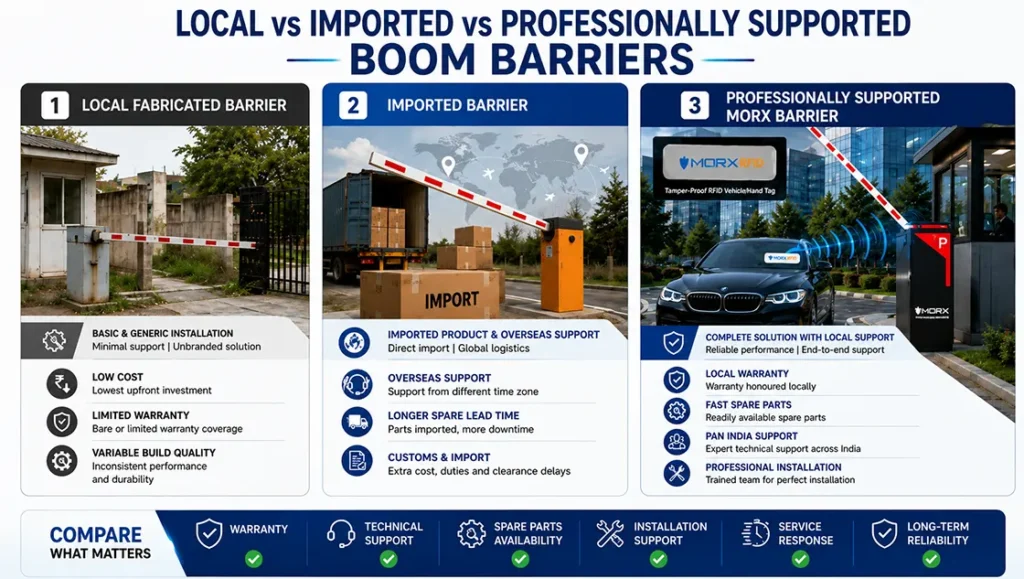
Side-by-Side Comparison
| Factor | Local / Unbranded | Directly Imported | Professionally Supported |
|---|---|---|---|
| Upfront Cost | Lowest | Variable, often mid-range | Moderate to higher |
| Build Consistency | Varies by fabricator | Consistent, factory-built | Consistent, factory-built |
| Warranty | Rare or informal | Manufacturer warranty, hard to claim locally | Locally honoured warranty |
| Spare Parts | Custom-fabricated, inconsistent | Import lead time, customs delays | Locally stocked / faster turnaround |
| Technical Support | Depends on the fabricator | Overseas support, time-zone gaps | Local pre- and post-sales support |
| Power Compatibility | Usually built for local voltage | May need conversion for 220V/50Hz | Built or verified for local standards |
| Documentation | Minimal or none | Available, sometimes not localised | Datasheets and specs available locally |
| Best Suited For | Very low-budget, low-criticality gates | Buyers with in-house import expertise | Businesses needing reliable uptime and support |
The Hidden Cost of the Cheapest Option
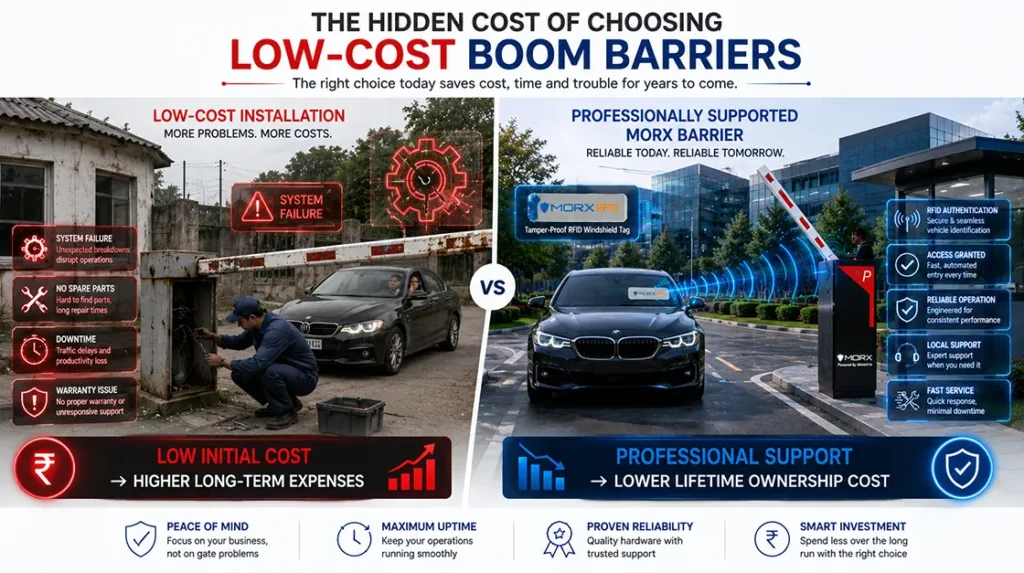
The sticker price on a local or imported barrier rarely tells the full story. A gate that fails during peak traffic hours, a gearbox that can’t be replaced for three weeks because the part has to be re-imported, or a warranty claim that goes nowhere because there’s no local contact — these all carry a real operational cost that doesn’t show up until after the purchase. For facilities where the gate is a daily operational dependency — a factory, a residential society with continuous vehicle flow, a commercial parking facility — that downtime cost frequently exceeds the price difference between a professionally supported barrier and a cheaper alternative.
What to Verify Before Choosing a Supplier
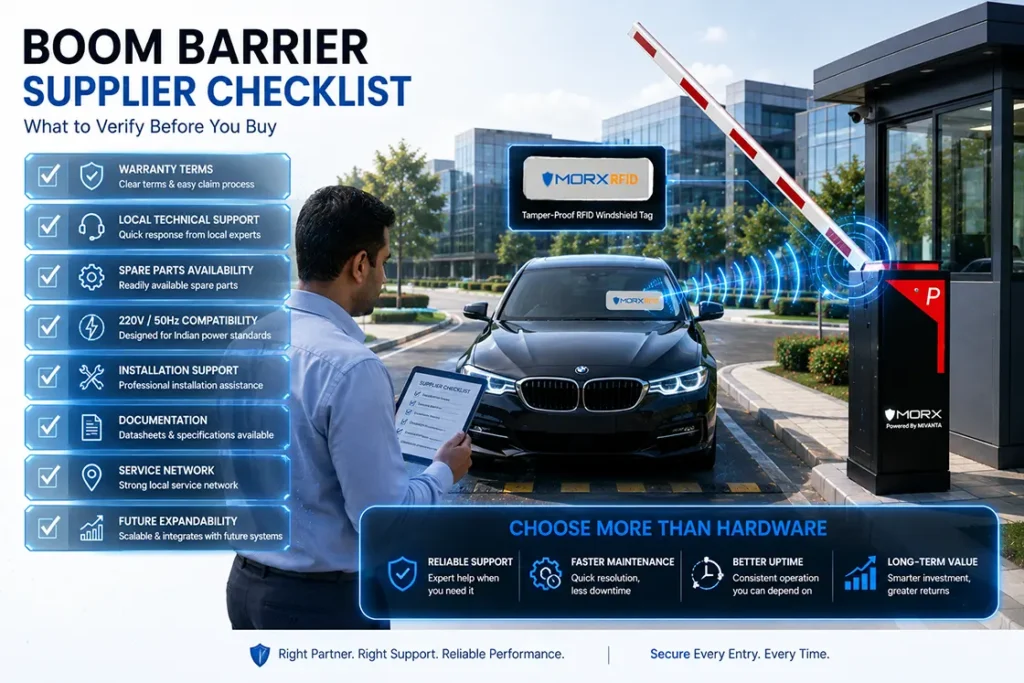
- Warranty terms in writing: Ask specifically how a claim is processed, and whether it requires the unit to leave the country
- Spare parts availability: Ask what the typical replacement time is for a gearbox, motor, or control board
- Documented specifications: A proper datasheet should exist before you buy — not something you have to request after installation
- Power compatibility: Confirm the unit is rated for local voltage and frequency without additional conversion equipment
- Local support contact: Confirm there’s a real technical support channel in your time zone, not just a sales contact
Frequently Asked Questions
Is a locally fabricated boom barrier ever a reasonable choice?
For very low-criticality applications — a rarely-used side gate, for example — a local fabricator can be an acceptable low-cost option. For any entrance a facility depends on daily, the lack of standardised build quality and warranty support usually outweighs the initial savings.
Why is warranty support harder with directly imported barriers?
Most overseas manufacturers’ warranty processes assume the buyer can ship the unit back to them, or that the manufacturer has a service presence in the buyer’s country. Without a local distributor, this typically means significant delay and shipping cost for what should be a routine warranty claim.
Does a professionally supported barrier cost significantly more?
It’s usually priced above unbranded local fabrication but is often comparable to, or only modestly above, the landed cost of a directly imported unit once customs duties, GST, and shipping are factored in — while including local warranty and support that the imported route doesn’t.
How do I know if a barrier is rated for Indian power standards?
Ask the supplier directly for the voltage and frequency rating before purchase, and request it in writing or on a datasheet. A barrier not explicitly rated for 220V/50Hz operation may need additional conversion hardware to run reliably.
Conclusion
The right sourcing route depends on how critical the entrance is to daily operations. For low-stakes, occasional-use gates, a local fabricator may be enough. For any facility where the barrier needs to work reliably every day — factories, residential societies, commercial parking, corporate campuses — a professionally supported barrier with local warranty backing, spare parts availability, and technical support is the option that avoids the hidden costs of the other two routes.
Explore the MB100 and MB200 Boom Barriers from Morx RFID’s Entrance Automation range, backed by local support and warranty. Contact the Morx RFID team for a site-specific recommendation.
CategoryBlog