
0

RFID tag encoding is a key process that enables accurate tracking and identification of items across modern industries. It involves writing important data—such as product details or unique IDs—onto RFID tags so they can be automatically read and processed.
With the growing use of RFID in manufacturing and supply chains, proper encoding ensures better traceability, real-time visibility, and fewer errors. In this blog, we give a clear overview of how RFID tag encoding works and why it matters.
What is RFID Tag Encoding?
RFID tag encoding refers to the process of writing specific data onto an RFID tag so it can be identified and tracked automatically. It ensures that each tag carries unique and meaningful information for use across systems.
- Microchip (Chip): The tiny electronic component inside the RFID tag that stores encoded data such as serial numbers or product information.
- Antenna: The metallic structure that enables the tag to send and receive signals from the RFID reader.
- Encoding Process: The method of programming data into the RFID chip using encoding devices or printers before the tag is deployed.
- RFID Reader/Writer: A device used to encode (write) and read data from RFID tags during setup and operation.
- Data Format: The structure or standard (such as EPC) used to organise the information stored on the tag for consistency and compatibility.
This process is essential for ensuring accurate tracking, traceability, and seamless integration across RFID systems.
Importance of Encoding
RFID tag encoding is essential for ensuring that each tag carries accurate and usable information. Proper encoding allows systems to identify, track, and manage items efficiently throughout their lifecycle.
Accurate Identification:
Ensures every item has a unique identity, reducing confusion and duplication.
Improved Traceability:
Helps track products, components, or assets across the entire supply chain.
Real-Time Visibility:
Enables instant data capture and monitoring of item movement and status.
Error Reduction:
Minimises manual data entry mistakes and improves overall data accuracy.
System Integration:
Ensures compatibility with ERP, WMS, or other business systems for smooth data flow.
Operational Efficiency:
Speeds up processes like inventory management, shipping, and receiving.
Effective encoding is the foundation of a reliable RFID system, directly impacting performance and business outcomes.
Memory Banks in RFID Tags
RFID tags are divided into different memory sections, known as memory banks, each designed for a specific function. Understanding these memory types is essential for effective encoding and data management.
Reserved Memory:
This memory bank stores security-related information such as access passwords and kill passwords. It helps protect the tag from unauthorised reading or modification, ensuring system security.
EPC (Electronic Product Code) Memory:
The EPC memory contains the unique identification code assigned to each tag. It is the primary data used for tracking items across manufacturing and supply chain processes.
TID (Tag Identifier) Memory:
TID memory holds a unique, factory-programmed serial number set by the manufacturer. This data is read-only and is used for authentication and verifying the originality of the tag.
User Memory:
User memory is an optional section that allows additional data to be stored on the tag, such as product details, batch numbers, or maintenance records. Unlike EPC, this memory can be customised based on application needs.
Together, these memory banks enable secure, flexible, and efficient use of RFID tags in various industrial applications.
The "Language" of Encoding: Hexadecimal vs. ASCII
When encoding data onto RFID tags, the format or “language” used plays a crucial role in how information is stored and interpreted. Two of the most commonly used formats are Hexadecimal (Hex) and ASCII (American Standard Code for Information Interchange).
Hexadecimal (Hex):
Hex is a compact, machine-friendly format that uses numbers (0–9) and letters (A–F) to represent data. It is widely used in RFID systems because it efficiently stores binary data and aligns well with standards like EPC. Hex encoding is ideal for unique identifiers, serial numbers, and system-level data processing.
ASCII:
ASCII is a human-readable format where each character (letters, numbers, symbols) is represented by a code. This makes it easier for users to understand and verify the encoded data directly. ASCII is often used when the stored information needs to be readable without decoding, such as product names or simple labels.
Key Difference:
While Hex is more efficient and commonly used for system operations, ASCII is easier for humans to read and interpret. The choice between the two depends on the application requirements, whether the priority is system performance or readability.
Understanding these encoding formats helps ensure accurate data storage, better system compatibility, and smoother RFID implementation.
The "Language" of Encoding: Hexadecimal vs. ASCII – Challenges and Limitations
While both Hexadecimal (Hex) and ASCII are widely used in RFID tag encoding, each comes with its own set of challenges that manufacturers and system integrators need to consider.
Challenges with Hexadecimal (Hex):
Hex is not human-readable, which makes it difficult for operators to understand or verify data without specialised tools. Even small encoding errors can go unnoticed and lead to incorrect tracking or system mismatches. Additionally, working with Hex often requires technical knowledge, making it less user-friendly for non-technical staff.
Challenges with ASCII:
ASCII is easy to read, but it is less efficient in terms of data storage. It requires more memory space compared to Hex, which can be a limitation for RFID tags with restricted memory capacity. This can reduce the amount of data that can be stored or increase costs when higher-memory tags are needed.
Data Consistency Issues:
Using both formats in the same system without proper standardisation can lead to confusion and compatibility problems. For example, the same data represented in Hex and ASCII will look completely different, which may cause errors in integration or data interpretation.
Performance Trade-offs:
Choosing between Hex and ASCII often involves a trade-off between efficiency and usability. Hex is better for system performance and compact storage, while ASCII is better for readability but may impact efficiency.
Understanding these limitations helps businesses choose the right encoding format and avoid common issues during RFID implementation.
Encoding Standards: GS1 and SGTIN
To ensure consistency and global compatibility in RFID systems, standardised encoding formats are essential. Two of the most widely used standards in RFID tag encoding are GS1 and SGTIN, which help organisations uniquely identify and track products across supply chains.
GS1 Standard:
GS1 is a global organisation that develops standards for business communication, including barcodes and RFID. It defines how data should be structured and encoded to ensure consistency across different systems and companies. By following GS1 standards, businesses can achieve better interoperability, accuracy, and seamless data exchange worldwide.
SGTIN (Serialised Global Trade Item Number):
SGTIN is a specific encoding format defined by GS1 for uniquely identifying individual products. It combines a company prefix, item reference, and a unique serial number to create a globally unique identifier for each item. This makes it possible to track not just product types, but individual units throughout their lifecycle.
Why These Standards Matter:
Using GS1 and SGTIN ensures that RFID data is standardised, scalable, and compatible across global supply chains. It reduces errors, improves traceability, and enables efficient tracking from manufacturing to end-user delivery.
Adopting these standards is key to building reliable and future-ready RFID systems.
Tools for RFID Encoding
There are three primary methods for encoding RFID tags:
- RFID Printers (High Volume): Encode and print labels simultaneously, ideal for large-scale operations through RFID software.
- Handheld Readers (Flexible Use): Portable devices for on-the-spot encoding, though slower and prone to stray reads.
- Desktop Readers (Precision): USB-connected pads for single-tag encoding, offering accuracy and reliability.
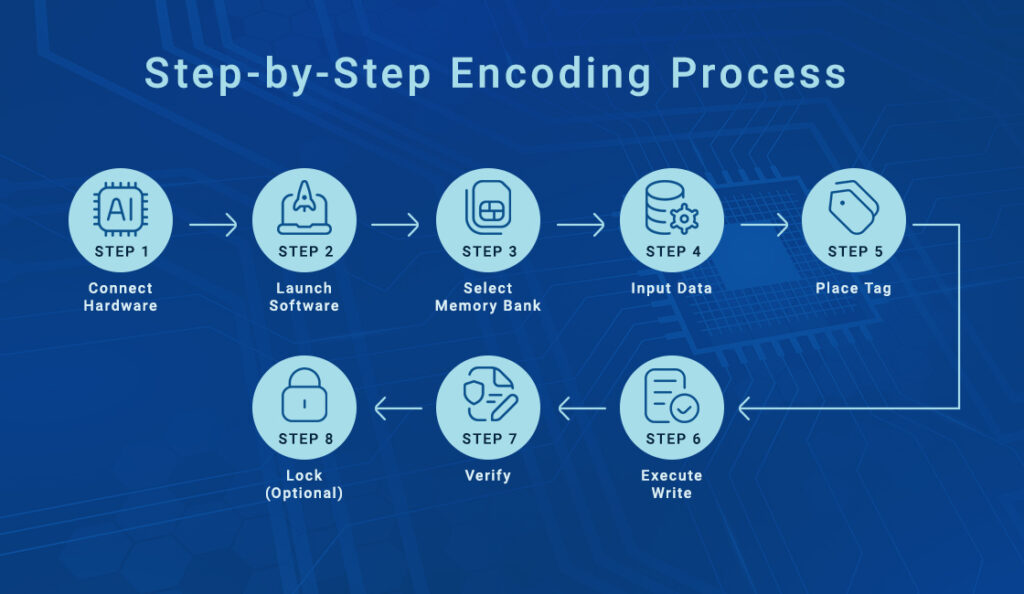
Step-by-Step Encoding Process
Using a desktop RFID reader, the process typically involves:
- Connect Hardware: Attach the reader to the computer.
- Launch Software: Open encoding software (e.g., Mivanta, Print Manager).
- Select Memory Bank: Choose “EPC.”
- Input Data: Type your desired number (e.g., 1234567890ABCDEF). Note: Ensure you are in Hex mode.
- Place Tag: Position the tag on the reader.
- Execute Write: Click “Write/Encode.” The reader powers up the chip and transfers the data.
- Verify: The software should immediately “Read” the tag back to confirm the new data matches what you sent.
- Lock (Optional): If you don’t want anyone changing it later, apply a “Lock” command to the EPC bank.
Applications of RFID Encoding
- Inventory Management:
Used to track stock levels in real time, reducing errors and improving warehouse efficiency. - Supply Chain Tracking:
Enables end-to-end visibility of goods from manufacturing to delivery. - Asset Tracking:
Helps monitor tools, equipment, and returnable assets to prevent loss and improve utilisation. - Retail and Product Identification:
Supports faster checkout, anti-theft systems, and accurate product identification. - Manufacturing Process Tracking:
Tracks work-in-progress items across production lines to improve efficiency and control. - Logistics and Shipment Management:
Enhances shipping accuracy, reduces delays, and ensures proper handling of goods.
Common Beginner Mistakes
Mistake
Incorrect Data Encoding |
Using the Wrong Memory Bank |
Skipping Testing Before Use |
Consequence
Leads to tracking errors and system mismatches |
Data may not be read properly or used correctly |
Results in unreadable tags and operational delays |
Conclusion
RFID tag encoding is a fundamental part of building an effective and reliable RFID system. From understanding memory banks and data formats to following proper standards and best practices, each step plays a crucial role in ensuring accurate tracking and seamless operations.
By avoiding common mistakes and implementing encoding correctly, businesses can improve efficiency, enhance traceability, and make better data-driven decisions. As RFID technology continues to grow, mastering tag encoding will be key to unlocking its full potential.
CategoryBlog