
0

How to Choose the Right UHF RFID Reader for Your Business
If you’ve started comparing UHF RFID readers for a warehouse, retail counter, or access gate, you’ve probably noticed the spec sheets don’t line up with each other – one vendor quotes read range, another quotes ports, a third just lists a protocol name. That mismatch is normal, because “UHF RFID reader” is actually a category covering several different device types built for different jobs, not one product with different price points.
This guide walks through what actually changes reader-to-reader, so you can narrow the field based on your application instead of a spec sheet alone.
What a UHF RFID reader actually does
A UHF RFID reader is the hardware that energizes passive RFID tags in its field and captures the identifier each tag returns. On its own, a reader only identifies a tag – turning that read into a stock count, a gate decision, or an inventory update depends on the antenna setup, the tag, and the software layer sitting behind the reader. When you’re evaluating readers, it helps to separate these pieces mentally: the reader, the antenna (built-in or external), the tag, and the system that interprets the data. A reader that performs well on paper can still underdeliver if the tags, mounting, or site conditions aren’t matched to it.
The main reader types, and when each one fits
Integrated UHF readers
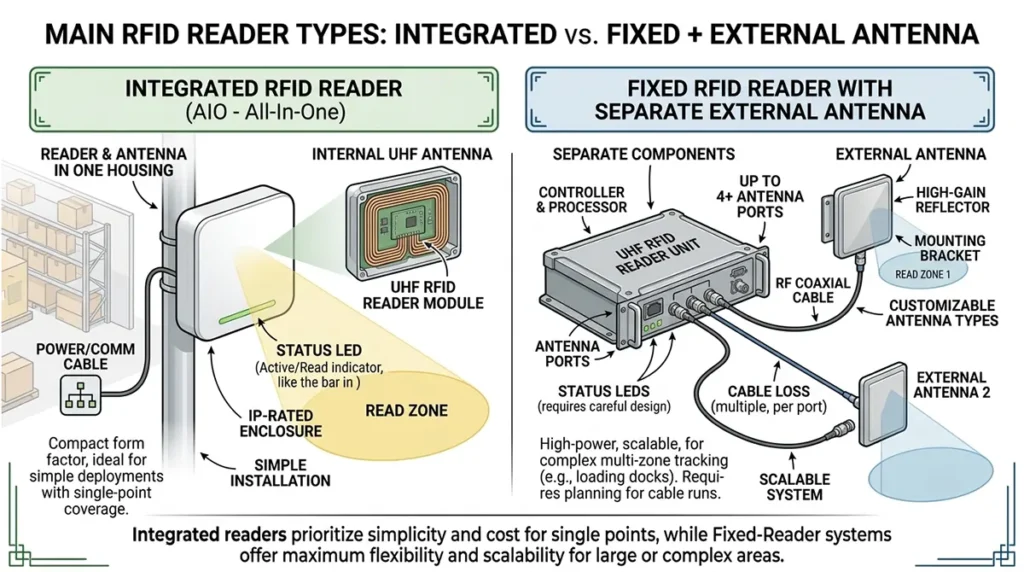
An integrated reader combines the reader electronics and antenna in one rugged enclosure, which simplifies installation since there’s no separate antenna cabling to run. These are generally built for continuous operation and are commonly deployed at fixed points such as gates, entry/exit lanes, or weighbridges, where the device can be mounted once and left running. MORX’s integrated UHF reader range includes models described for applications like vehicle identification, parking automation, and weighbridge or asset tracking – worth reviewing if your use case is a single fixed checkpoint rather than a wide read zone.
Fixed readers (with external antennas)
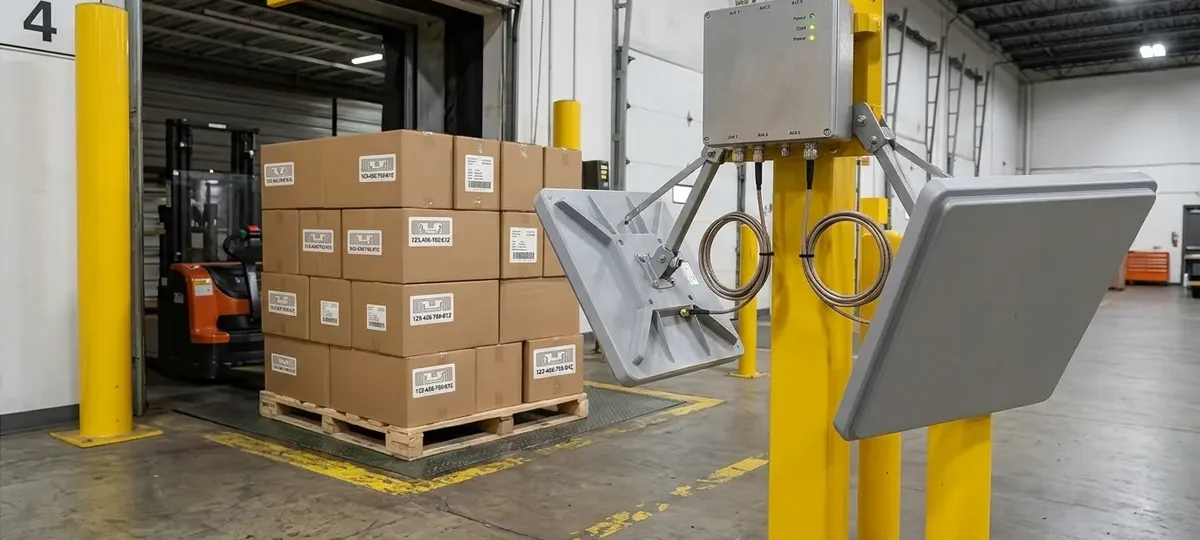
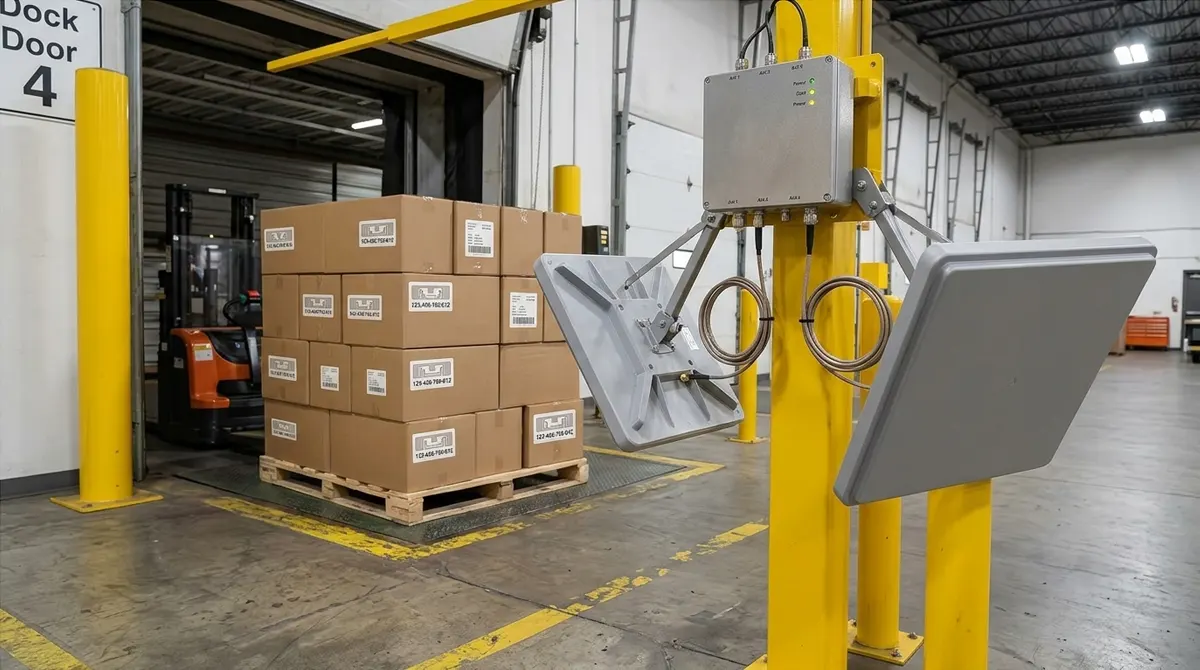
A fixed reader is a separate unit connected to one or more external antennas, which gives you more control over antenna placement, count, and orientation than an integrated unit. This matters in environments like conveyor lines, dock doors, or multi-lane gates, where you may need several antennas angled differently to cover a wider or more irregular read zone, or to add antennas later as the deployment grows. Fixed readers also tend to offer more physical ports and middleware integration options, since they’re usually the hub of a larger multi-point system. MORX’s fixed reader category lists models with varying port counts, which is the detail to check first if you’re scaling beyond a single read point.
Handheld readers
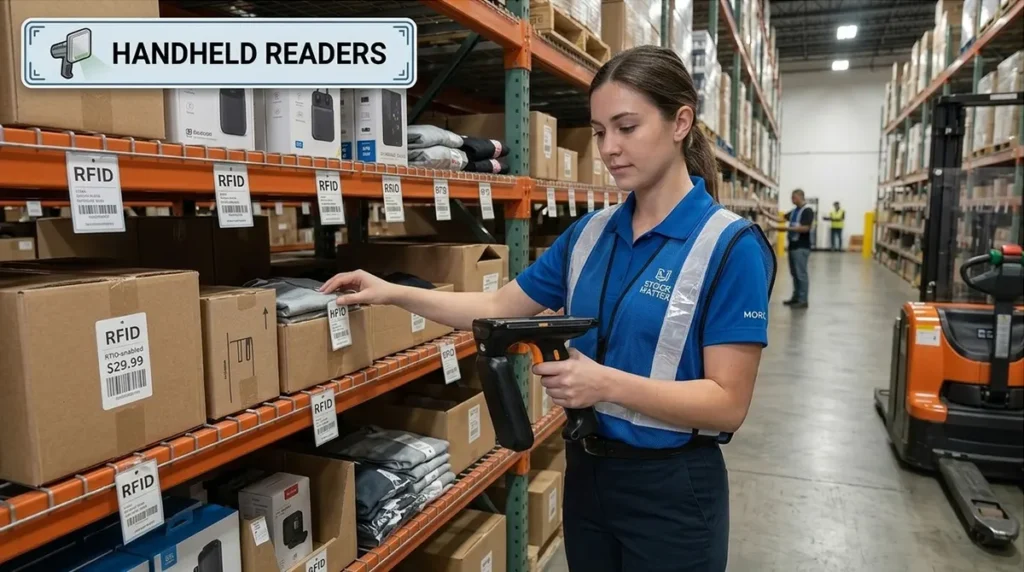
Handheld readers are built for mobile, operator-driven scans – cycle counts, spot checks, or locating a specific item in a large storage area – rather than unattended, continuous reading. They trade the wider or more consistent read zone of a fixed installation for portability.
Desktop reader/writers
A compact, USB-powered desktop unit is meant for close-range work at a single workstation – tag encoding, enrollment, or verifying a tag before it goes on an item – not for reading tags as they move through a zone.
What actually determines performance (and what doesn't)
This is the part most comparison articles skip, and it’s where unrealistic expectations usually start:
- Read range is a deployment outcome, not a fixed number. Any range figure a manufacturer publishes assumes specific test conditions – tag type, orientation, antenna gain, and open-air space. Real-world range on a crowded pallet, near metal shelving, or around liquids will differ. Ask any vendor for range figures under conditions close to yours, or plan to test on site.
- Tag compatibility isn’t universal. Not every passive UHF tag performs the same on every reader, and tags on metal or near liquid generally need tag designs built for that (on-metal tags, for instance), not a standard label.
- Frequency and regional configuration matter. UHF RFID operates in a regulated band that varies by country; confirm a reader’s regional configuration matches where it will be deployed.
- Interference and placement are often the real bottleneck. Metal racking, other readers nearby, and antenna angle relative to tag orientation affect reads as much as the reader’s rated power.
- Protocol compatibility is usually a non-issue, but still worth confirming. Most commercial UHF hardware, including MORX’s reader lines, follows EPCglobal Gen2 / ISO 18000-6C, which covers interoperability with Gen2-compliant tags – but always confirm this against the specific model and tag you’re pairing.
(Any reader’s exact read range, output power, certifications, or ingress protection rating should be confirmed directly against the current product page or with MORX before you finalize a purchase – these details vary by model and are the kind of spec that goes out of date in a generic article.)
A practical selection checklist
Use this as a working checklist when you’re comparing options rather than deciding on read range or price alone:
| Factor | Questions to answer before choosing |
|---|---|
| Application | Is this a fixed checkpoint (gate, dock door), a wide conveyor/line zone, or mobile/manual scanning? |
| Read zone | Do you need one antenna or several? Integrated readers suit single points; fixed readers with external antennas suit wider or multi-lane zones. |
| Tag type & placement | What’s being tagged – cartons, metal assets, garments, vehicles? This affects tag choice as much as reader choice. |
| Environment | Dust, vibration, outdoor exposure, or temperature extremes may call for an industrial-rated enclosure. |
| Connectivity | Does the reader need to talk to an existing ERP/WMS/MES? Confirm API or middleware support before committing. |
| Scale | Will you add more antennas, lanes, or readers later? Fixed, multi-port systems generally scale more easily than integrated single-unit readers. |
| Pilot testing | Can you test the reader against your actual tags and site conditions before a full rollout? |
Running a small pilot – even a single reader and antenna at one checkpoint – before committing to a full deployment is the most reliable way to validate real-world read range and placement, since no spec sheet can fully substitute for your actual site conditions.
Where to go from here
If your use case is a single fixed point – a gate, a weighbridge, a parking lane – an integrated reader is usually the simpler install. If you’re covering a wider zone, multiple lanes, or expect to scale, a fixed reader with external antennas gives you more flexibility. Either way, confirm regional frequency configuration, tag compatibility, and realistic read range for your environment before you buy, and treat a short pilot as part of the decision, not an optional extra.
MORX RFID’s RFID smart equipment range extends beyond readers alone, covering adjacent hardware worth reviewing if your deployment includes inventory counting or checkout touchpoints alongside reader infrastructure.
If you’re still weighing options for your specific site, MORX RFID solutions can walk through reader types against your actual application, or you can go straight to request an RFID reader recommendation with details of your use case, environment, and existing systems.
Frequently Asked Questions
Does a longer read range always mean a better reader?
Not necessarily. A longer range is only useful if your application needs it – a dense read zone with many closely spaced tags often performs better with a controlled, shorter range than an aggressive long-range setup that picks up unwanted reads from adjacent zones.
Can I use any UHF tag with any UHF reader?
Generally, Gen2-compliant tags work across Gen2-compliant readers, but tag design (standard label vs. on-metal vs. hard tag) still needs to match the surface and environment it’s applied to – confirm this for your specific tags and reader model.
Do I need a fixed reader or will an integrated reader work?
If you have one checkpoint and don’t expect to expand antenna coverage, an integrated reader is usually simpler. If you need multiple antennas, wider coverage, or plan to scale, a fixed reader with external antennas is generally more flexible.
How do I know what read range I'll actually get on site?
Test before you commit. Published range figures are measured under specific conditions that rarely match a working warehouse or gate exactly – a short on-site pilot is the most reliable way to know.
Does MORX RFID manufacture these readers or supply them?
MORX RFID is positioned as a supplier and distributor of RFID hardware; confirm manufacturing origin and support terms for a specific model directly with MORX.
CategoryBlog