
0

Choosing the Right RFID Reading Range: 6m vs 15m vs 20m Readers
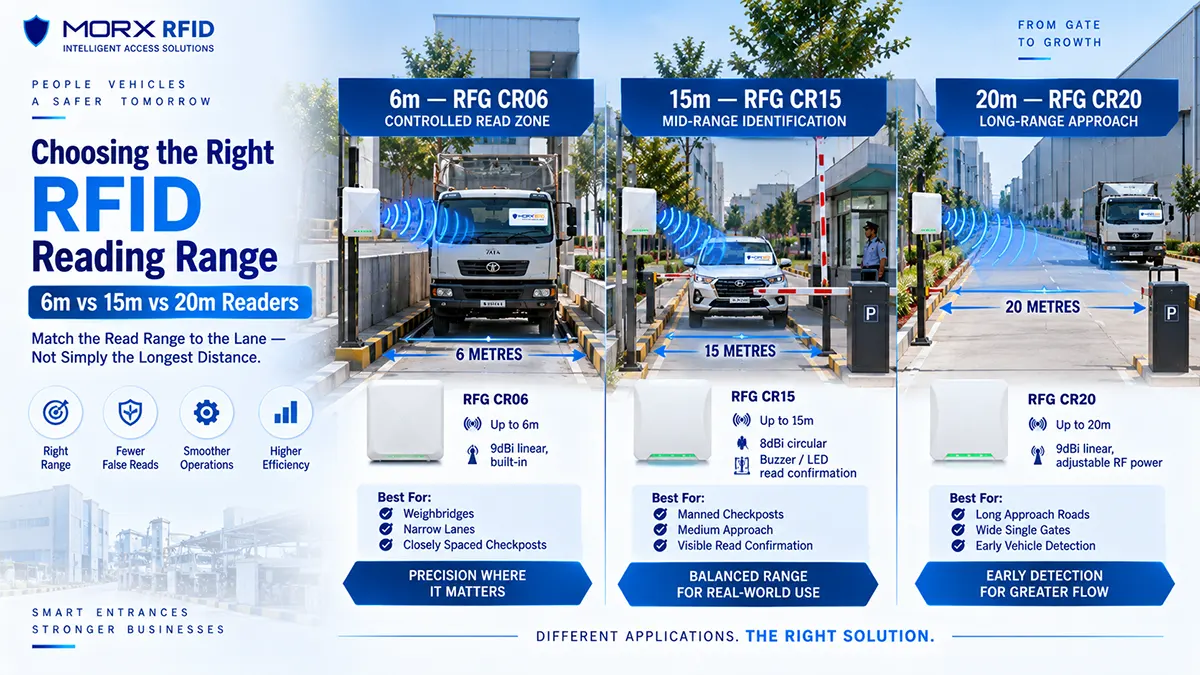
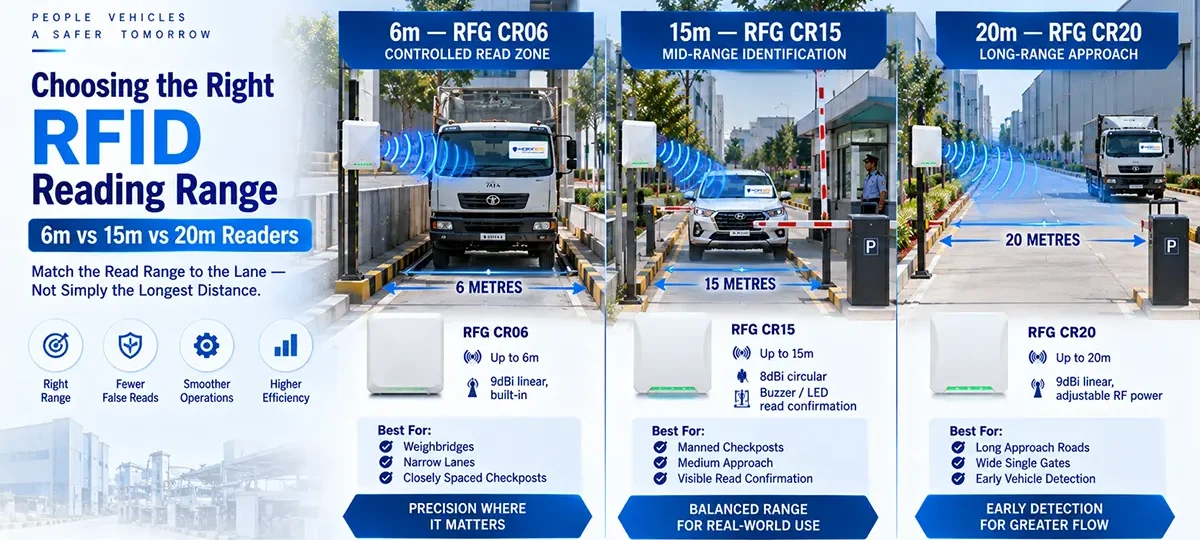
The most common mistake in specifying an RFID reader isn’t choosing too little range it’s choosing too much. A longer read range sounds like a safe, future-proof choice, but at a real installation it can cause exactly the problem you’re trying to avoid: false reads, cross-lane interference, and vehicles being identified before you actually want them to be. Choosing between a 6m, 15m, or 20m reader comes down to matching range to your specific lane layout, not simply picking the longest number available.
Why Longer Range Isn't Automatically Better
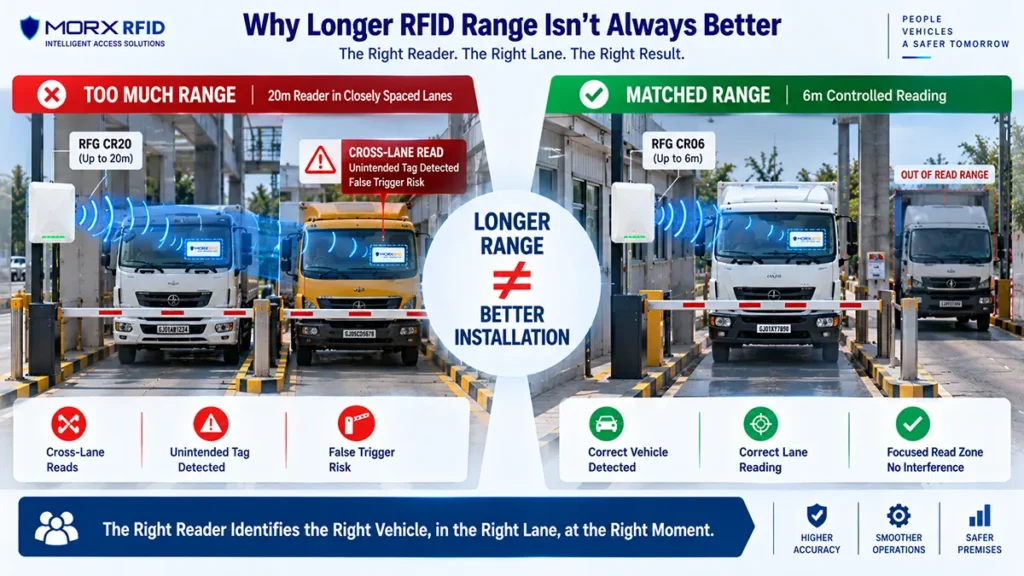
A reader’s job is to identify the right vehicle, in the right lane, at the right moment. Range that exceeds what your site layout actually needs creates a specific problem: the reader starts picking up tags from vehicles that aren’t actually approaching that gate a car in an adjacent lane, a vehicle parked nearby, or traffic on a neighbouring access road. This shows up as inconsistent behaviour: barriers triggering for the wrong vehicle, or logs showing reads that don’t correspond to an actual gate crossing.
The right approach is to match reader range to your actual physical layout lane width, approach distance, and how close the next lane or road is rather than defaulting to the longest range on the spec sheet.
The Three Ranges Explained
6 Metres — Controlled, Narrow-Zone Reading
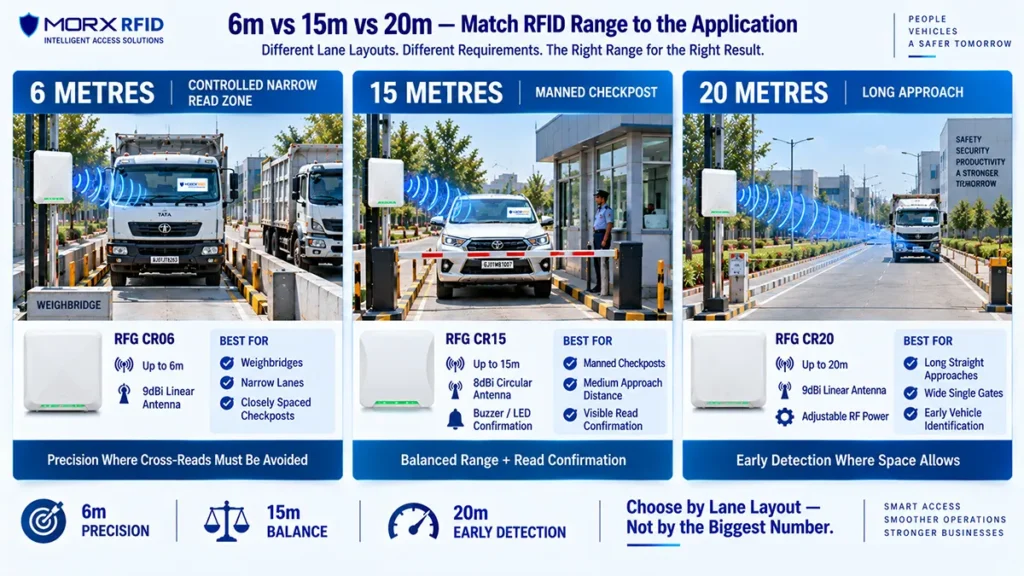
The RFG CR06 reads up to 6 metres with a 9dBi linear antenna, purpose-built for situations where a wide read zone would actually cause problems. This is the right range where the vehicle is already confined to a narrow, defined path — a weighbridge platform, a tightly spaced multi-lane checkpost, or any point where reading only the vehicle directly in the lane matters more than detecting it early.
15 Metres — Mid-Approach with Read Confirmation
The RFG CR15 extends to 15 metres with an 8dBi circular antenna, and adds a buzzer or LED prompt that confirms a successful read in real time. This makes it well suited to checkposts that are still staffed alongside the automated system — the visible or audible confirmation lets an operator know the read happened without needing to check a screen.
20 Metres — Longest Approach Detection
The RFG CR20 reads up to 20 metres, with adjustable RF power and a built-in 9dBi linear antenna. This is the right choice when a gate has a genuinely long, straight approach — an industrial site entrance with significant standoff distance, or a single wide gate where you want the vehicle identified and the barrier already opening well before it arrives.
Side-by-Side Comparison
| Reader | Range | Antenna | Standout Feature | Best Lane Type |
|---|---|---|---|---|
| RFG CR06 | Up to 6m | 9dBi linear, built-in | Controlled, narrow read zone (<200 tags | Weighbridges, narrow multi-lane checkposts |
| RFG CR15 | Up to 15m | 8dBi circular | Buzzer / LED read confirmation | Manned checkposts needing visible read confirmation |
| RFG CR20 | Up to 20m | 9dBi linear, adjustable RF power | Longest approach detection distance | Long straight approach roads, wide single gates |
How to Match Range to Your Actual Site
Four physical factors should drive your range decision, in this order of importance:
- Distance to the next lane or road: This is the factor most people skip. If another lane, road, or parking area sits within your intended read range, a longer-range reader will pick up tags from it. Measure this before choosing range, not after installation
- Available approach distance: How much straight road does the vehicle have before reaching the barrier? A 20m reader is wasted on a gate with only 8 metres of approach
- Lane width and containment: A physically narrow, walled, or channelled lane can safely use a longer range, since there’s little risk of reading an adjacent vehicle
- Vehicle approach speed: Faster-moving traffic benefits from earlier detection — favouring 15m or 20m — while slow, queued traffic works fine with a 6m read zone
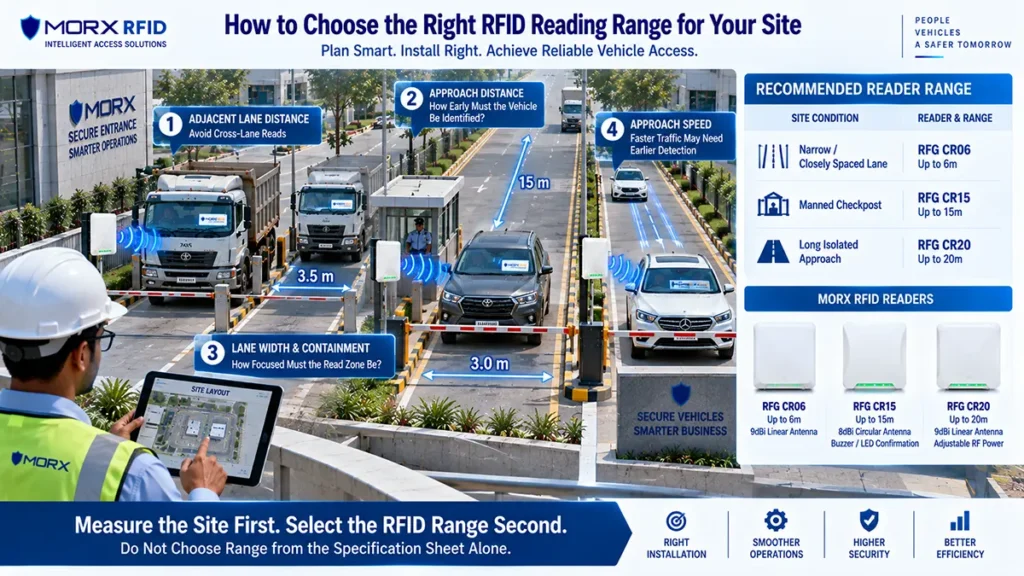
The Common Mistake: Over-Ranging a Narrow Multi-Lane Site
The most frequent specification error is installing a 20m reader at a checkpost with multiple lanes spaced only a few metres apart — like a weighbridge facility with two or three parallel lanes. At that range, a reader in lane one can easily pick up a tag from a vehicle in lane two, causing the wrong barrier to trigger or a read logged against the wrong lane entirely. For exactly this scenario, the RFG CR06‘s controlled 6-metre range isn’t a limitation — it’s the correct specification.
Quick Selection Guide
- Choose 6m (CR06) if: Lanes are closely spaced, the vehicle is already confined to a narrow path, or you’re reading at a weighbridge platform
- Choose 15m (CR15) if: You have a staffed checkpost that benefits from visible read confirmation alongside automated identification
- Choose 20m (CR20) if: You have a long, isolated approach road and want the vehicle identified well before it reaches a single, wide gate
All three are part of Morx’s UHF Integrated Reader range, designed to pair with Windshield Tags and Entrance Automation hardware for a complete vehicle access setup.
Frequently Asked Questions
Can I just install the longest-range reader everywhere to be safe?
No — this is the most common specification mistake. Excess range at a site with closely spaced lanes or nearby roads causes cross-reads and false triggers rather than improving reliability. Range should match the site layout, not default to the maximum available.
Does read range affect how fast the barrier opens?
Indirectly — a longer-range reader identifies the vehicle earlier in its approach, giving the system more time to verify and trigger the barrier before the vehicle arrives. But this only helps if there’s enough physical approach distance to use that extra range meaningfully.
What happens if the read range is too short for my site?
The vehicle may reach the barrier before the tag is read and verified, forcing it to slow down or stop rather than passing through smoothly. This is the opposite failure mode to over-ranging, and is why matching range to actual approach distance matters in both directions.
Can antenna gain be adjusted instead of buying a different reader?
Some readers, including the RFG CR20, support adjustable RF power output, which allows some tuning of effective range within that model’s specification. However, this adjusts intensity within the reader’s designed range band — it doesn’t turn a 6m reader into a 20m reader or vice versa.
Conclusion
The right RFID reading range isn’t about buying the most powerful reader available — it’s about matching range to your lane width, approach distance, and how close the next lane sits. A 6m reader at a tightly spaced checkpost and a 20m reader at an isolated single gate are both the correct choice for their respective sites, even though the numbers look very different on a spec sheet.
Explore the RFG CR06, RFG CR15, and RFG CR20 from Morx RFID’s UHF Integrated Reader range. Contact the Morx RFID team with your lane dimensions for a site-specific range recommendation.
CategoryBlog