
0

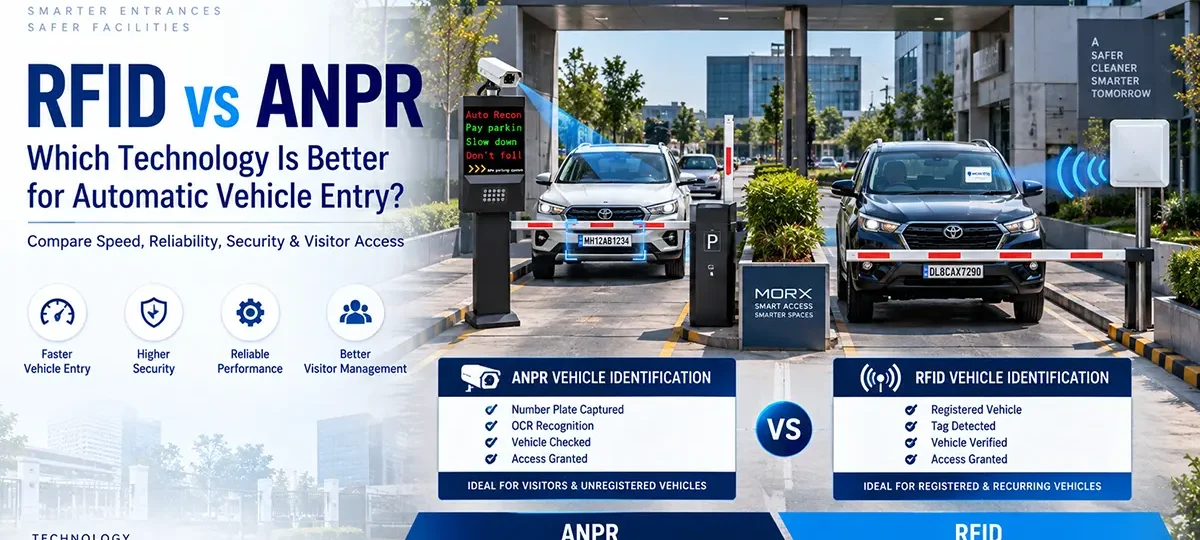
RFID vs ANPR: Which Technology Is Better for Automatic Vehicle Entry?
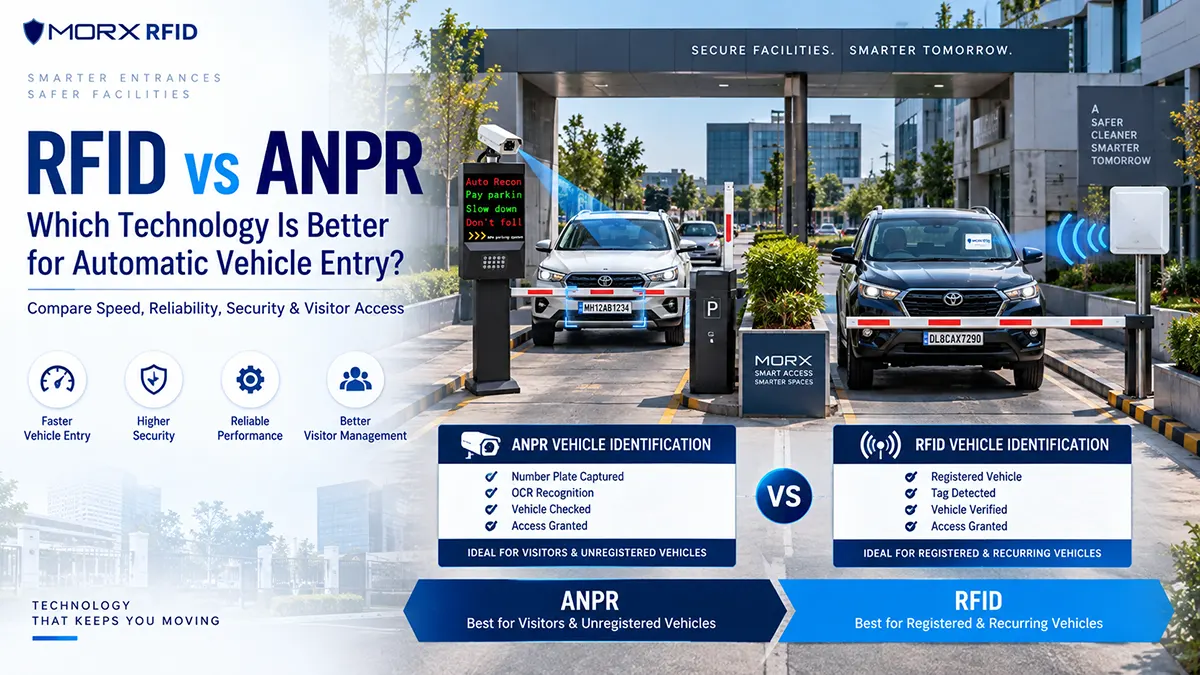
Both RFID and ANPR promise the same outcome — a vehicle drives up, gets identified automatically, and the barrier opens without a guard checking anything. But the two technologies work in completely different ways, and that difference matters a lot depending on what kind of vehicles are entering your facility. This guide breaks down how each one actually works, where each performs better, and when it makes sense to use both together.
What Is RFID Vehicle Identification?
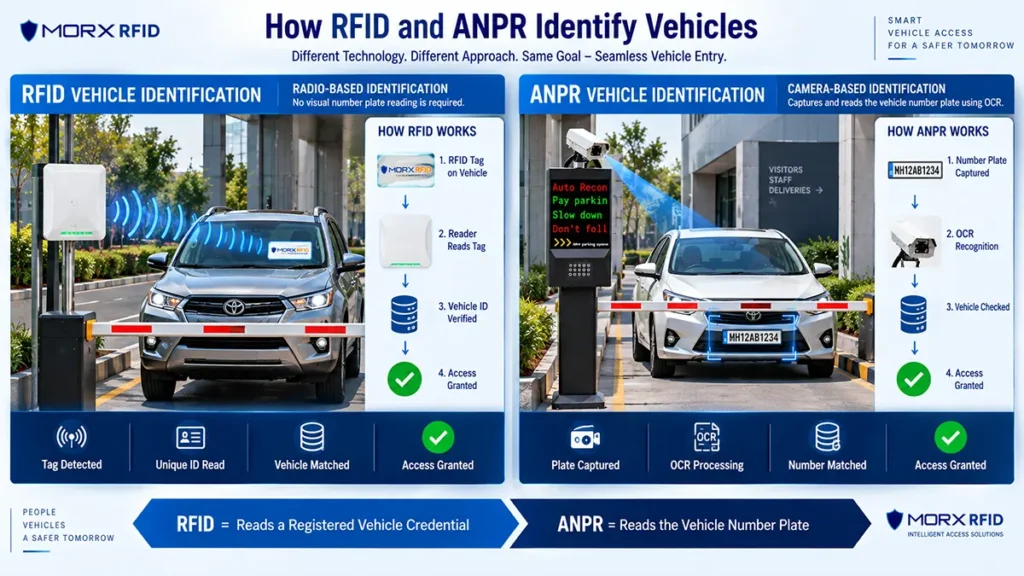
RFID vehicle identification uses a tag — typically mounted on the vehicle’s windshield — that transmits a unique ID to a nearby reader via radio frequency. As the vehicle approaches a gate, the reader picks up the tag automatically, checks the ID against an authorised list, and triggers the barrier if it’s valid. The vehicle doesn’t need to stop, and the read doesn’t depend on visibility, lighting, or the tag facing any particular direction.
What Is ANPR?
RFID vehicle identification uses a tag — typically mounted on the vehicle’s windshield — that transmits a unique ID to a nearby reader via radio frequency. As the vehicle approaches a gate, the reader picks up the tag automatically, checks the ID against an authorised list, and triggers the barrier if it’s valid. The vehicle doesn’t need to stop, and the read doesn’t depend on visibility, lighting, or the tag facing any particular direction.
How Each Technology Actually Performs at the Gate
RFID in Practice
A Windshield Tag mounted on the vehicle is read by a fixed reader — such as the RFG CR20, which reads tags up to 20 metres away. Because the read is a direct radio signal rather than a visual capture, performance stays consistent regardless of ambient light, fog, or how dirty the plate is — the tag either transmits its ID or it doesn’t, with no interpretation step involved.
ANPR in Practice
An ANPR camera, such as Morx’s ANPR Parking Control System, needs a clear, well-lit view of the plate to read it accurately. Modern systems handle most conditions well, but accuracy can still be affected by heavy dirt on the plate, unusual mounting angles, extreme glare, or plates that don’t conform to the standard format the OCR engine expects.
RFID vs ANPR — Side-by-Side Comparison
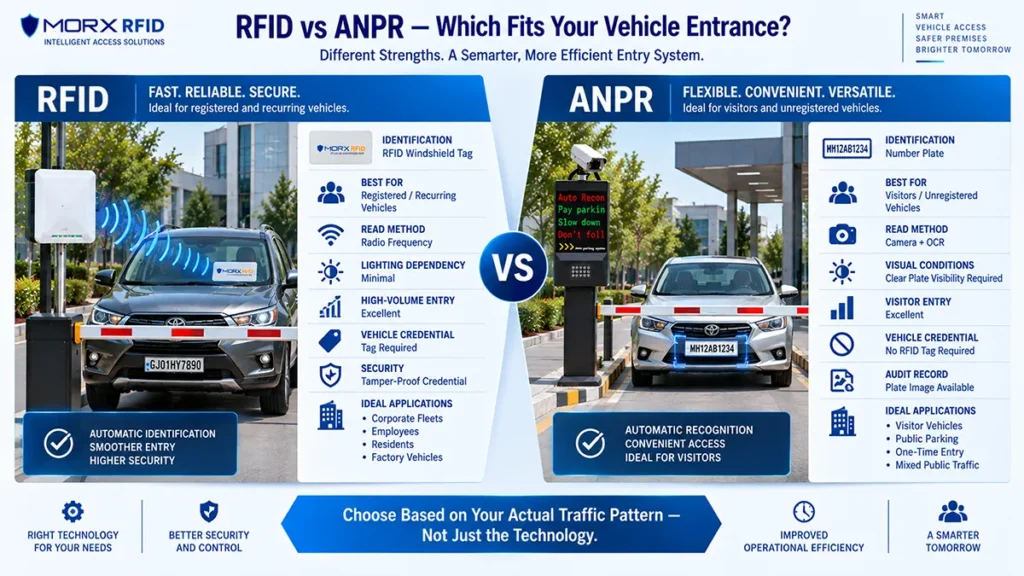
| Factor | RFID | ANPR |
|---|---|---|
| Identification Method | Radio tag mounted on the vehicle | Camera reads the number plate via OCR |
| Vehicle Tagging Needed | Yes — every vehicle needs a registered tag | No — works on any vehicle’s existing plate |
| Read Reliability | Consistent — unaffected by lighting or plate condition | Depends on lighting, plate visibility, dirt, and angle |
| Speed at High Volume | Very fast — reads tag before vehicle stops | Fast, but can be slowed by poor plate visibility |
| Setup for Visitor Vehicles | Requires issuing a tag or a separate visitor process | Works immediately, no tag issuance needed |
| Security Against Spoofing | High — tamper-proof tags can’t be duplicated easily | Lower — a cloned or altered plate can bypass the system |
| Weather Sensitivity | Minimal impact from rain, fog, or low light | Fog, heavy rain, or glare can reduce plate readability |
| Best Fit | Known, recurring vehicles — residents, employees, fleet | Unknown or visitor vehicles — public parking, one-time entry |
Where RFID Has the Advantage
- Known, recurring vehicles: Residential societies, corporate campuses, and factories where the same vehicles enter daily benefit from a tag that only needs to be issued once
- Weather-exposed entrances: Radio signal reads aren’t affected by fog, heavy rain, or poor lighting the way a camera-based read can be
- High-security requirements: A tamper-proof tag is significantly harder to spoof than a physical number plate, which can be cloned or altered
- Very high approach speeds: Long-range readers identify a vehicle well before it reaches the barrier, without needing the vehicle to slow for a clear camera shot
Where ANPR Has the Advantage
- Visitor and one-time vehicles: No tag issuance process needed — the system works on any vehicle’s existing plate immediately
- Public parking facilities: Where tagging every visiting vehicle isn’t practical, ANPR identifies vehicles without any hardware installation on the vehicle itself
- Lower per-vehicle cost: No tag cost per vehicle, since ANPR only requires camera infrastructure at the gate, not hardware on each car
- Investigative and audit use: Captured plate images provide a visual record useful for security review, which a radio-only RFID read doesn’t provide on its own
Can You Use Both Together?
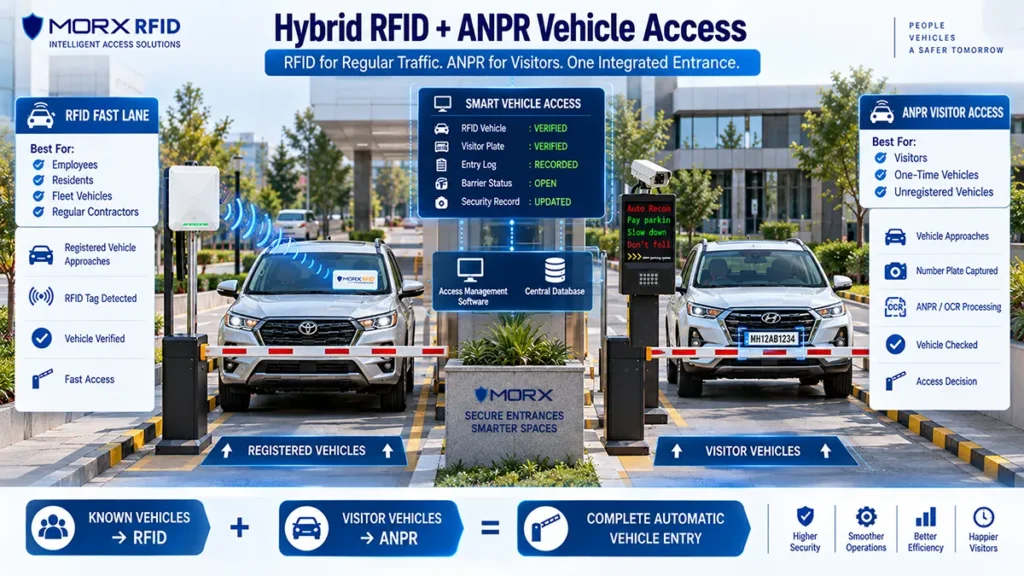
Yes — and many facilities do, precisely because RFID and ANPR cover each other’s weak points. A common setup uses RFID for registered, recurring vehicles — residents, employees, fleet — for fast, reliable daily access, with ANPR running in parallel to handle visitor vehicles and provide a visual backup record for every entry, tagged or not. This hybrid approach is common in Smart Parking deployments, where RFID handles the bulk of predictable traffic and ANPR fills the gap for anyone without a registered tag.
Which Should You Choose?
If most of your traffic is a known, repeating set of vehicles — go with RFID.
If most of your traffic is visitors or unregistered vehicles you can’t practically tag — go with ANPR.
If your facility has a mix of both — resident/employee traffic plus regular visitors — a hybrid RFID + ANPR setup typically delivers the best overall reliability.
Frequently Asked Questions
Is RFID more accurate than ANPR?
For registered vehicles with a properly mounted tag, RFID reads are generally more consistent since they don’t depend on visual conditions. ANPR accuracy is very high under good conditions but can be affected by dirty plates, unusual angles, or poor lighting — RFID doesn’t have this variability.
Is RFID more accurate than ANPR?
The core plate capture and matching can often run locally at the gate, similar to RFID. Centralised logging, reporting, and remote management typically use network connectivity, but this is an implementation detail that varies by system rather than a fundamental limitation of ANPR itself.
Can someone bypass an RFID system by removing the tag?
A standard adhesive tag can theoretically be moved between vehicles, which is exactly why tamper-proof windshield tags matter for serious vehicle access deployments — they’re built so removal damages the tag rather than allowing clean transfer to another vehicle.
Which is cheaper to deploy — RFID or ANPR?
ANPR typically has lower per-vehicle cost since it doesn’t require tagging each vehicle, but the camera hardware itself can be a larger upfront investment than an RFID reader. RFID has an ongoing per-vehicle tag cost but often lower per-read operational complexity. The cheaper option depends heavily on your vehicle volume and how many are repeat visitors versus one-time entries.
Conclusion
Neither RFID nor ANPR is universally better — they solve the same problem for different traffic patterns. RFID excels with known, recurring vehicles and weather-exposed or high-security entrances; ANPR excels where tagging every vehicle isn’t practical, particularly for visitor and public traffic. For facilities with a mix of both, combining the two gives you reliable automated access without leaving visitor traffic unhandled.
Explore Morx RFID’s Windshield Tags, UHF Integrated Reader range, and ANPR Parking Control System, or visit our Entrance Automation range to see how both technologies integrate with boom barrier hardware. Contact the Morx RFID team for a traffic-pattern-specific recommendation.
CategoryBlog