
0

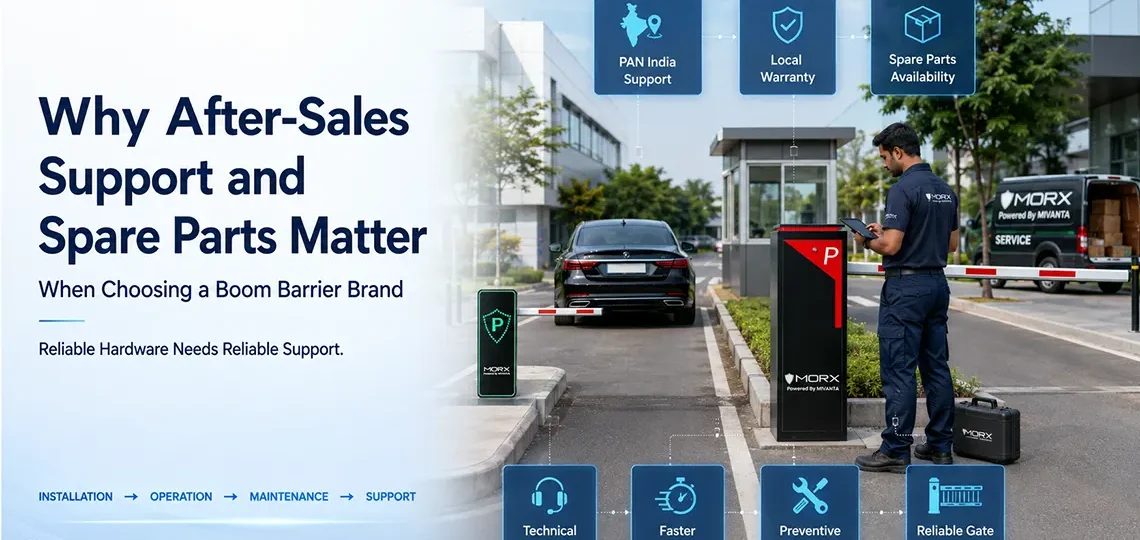
Why After-Sales Support and Spare Parts Matter When Choosing a Boom Barrier Brand
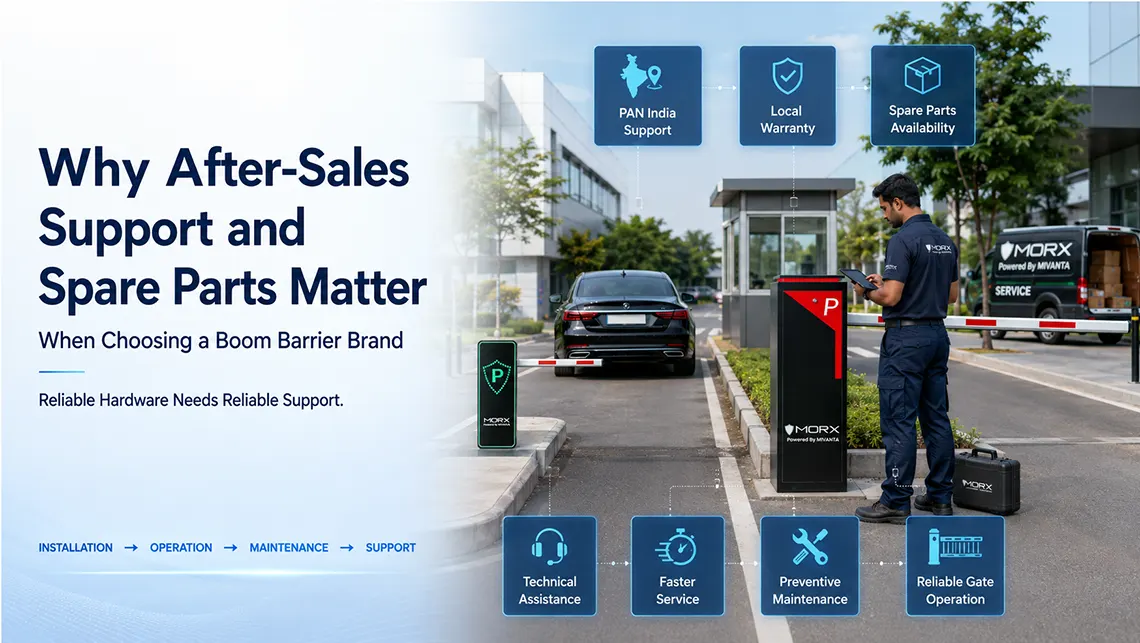
A boom barrier purchase decision almost always focuses on the same handful of specs — arm length, motor type, IP rating. What rarely gets asked, and matters just as much over the barrier’s working life, is a simpler question: when this breaks, how fast can it be fixed? A boom barrier isn’t a one-time purchase — it’s a mechanical device that will need servicing, and the brand you choose determines whether that servicing takes a day or takes three weeks.
A Boom Barrier Is a Mechanical Commitment, Not a One-Time Purchase
Every boom barrier, regardless of brand or price point, has moving parts that wear with use — a motor and gearbox doing thousands of open-close cycles, a control board handling continuous electrical load, a spring mechanism under constant mechanical stress. None of this is a defect; it’s normal wear on any mechanical access system operating daily, sometimes hundreds of times a day at a busy entrance.
The question isn’t whether the barrier will eventually need a part replaced — it’s what happens on the day it does.
What Actually Wears Out — and What Happens If You Can't Get the Part
| Component | Why It Wears | Impact If Unavailable |
|---|---|---|
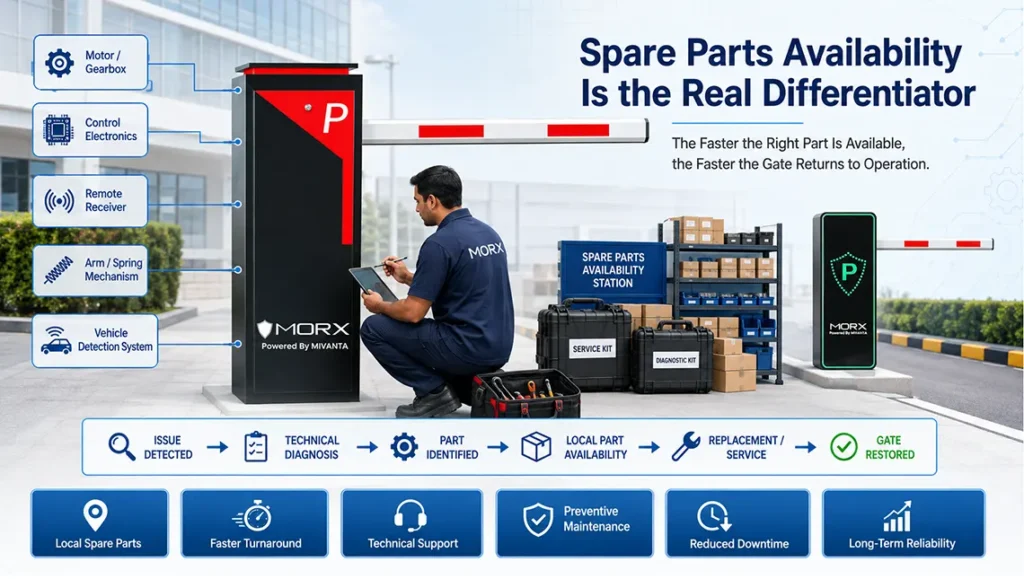
| Motor / Gearbox | Continuous mechanical cycling — the highest-use moving part in the system | Barrier stops opening/closing entirely; gate becomes manual or unusable |
| Control Board | Electrical wear, power surges, moisture ingress in outdoor installs | Loss of automated control — remote and RFID triggers stop working |
| Remote Receiver Module | Frequency drift, moisture, general electronic ageing | Remote-based manual override stops functioning |
| Arm / Counterweight Spring | Mechanical fatigue from thousands of open/close cycles | Arm movement becomes jerky, unsafe, or fails to fully lift |
| Ground Sensor Loop | Cable wear, water ingress, physical damage from vehicle traffic | Vehicle presence detection fails, risking arm closing on a vehicle |
The Real Cost of Poor After-Sales Support
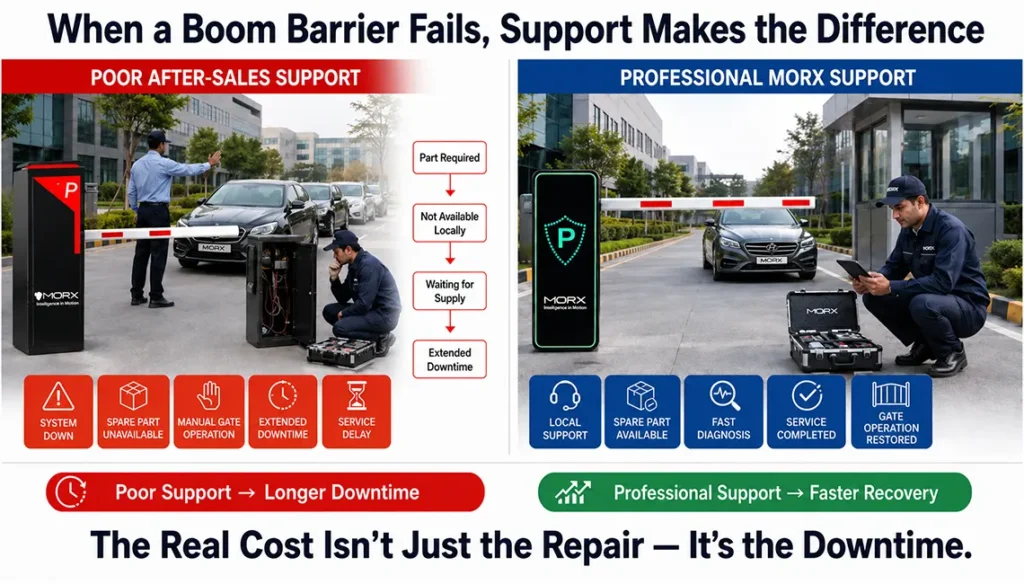
When a component fails and the part isn’t readily available, the cost isn’t just the repair — it’s everything that happens while the gate is down:
- Security exposure: A barrier stuck open removes access control entirely; a barrier stuck closed blocks a facility’s only entrance
- Operational disruption: Manual gate operation during the downtime means reassigning staff to a task the barrier was meant to eliminate
- Extended downtime from import delays: If the part has to be sourced from overseas, days of downtime can stretch into weeks once shipping and customs are factored in
- Repeated visits for the same issue: Without a technician familiar with the exact model, diagnosis can take multiple site visits instead of one
None of this shows up in the barrier’s price tag at the time of purchase — it only becomes visible the first time something needs fixing.
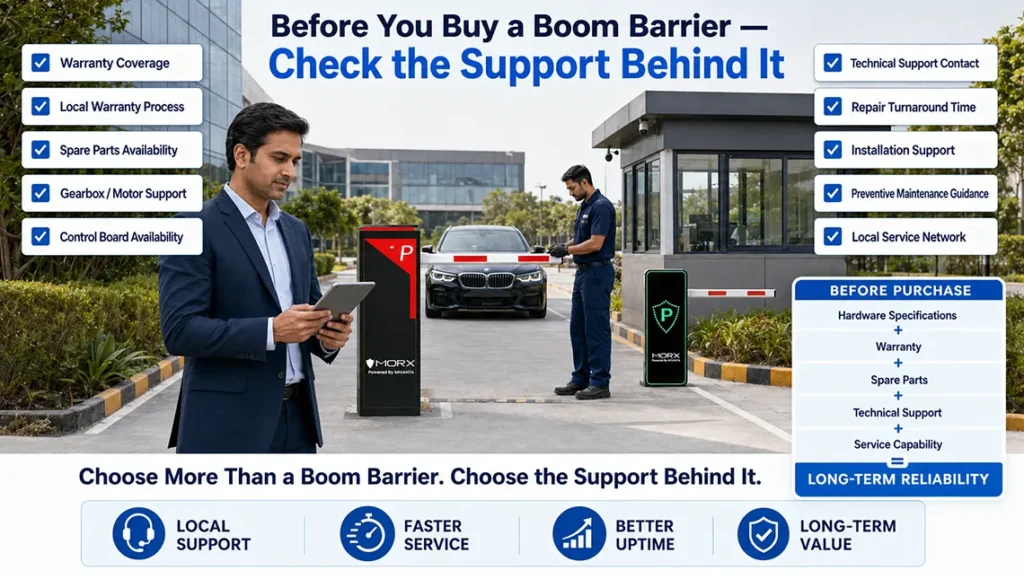
What to Look For in a Boom Barrier Brand's Support
- Warranty honoured locally: A warranty that requires shipping the unit overseas for a claim is a warranty that’s difficult to actually use
- Spare parts stocked in-country: Ask specifically whether critical parts — gearbox, control board, remote module — are held in local stock or ordered per-failure
- Documented maintenance guidance: A brand that provides a clear service schedule helps you catch wear before it becomes a failure
- Responsive technical support: Confirm there’s a real support channel — not just a sales contact — that can help diagnose an issue over a call before a technician visit is even needed
- Installation and training support: Proper initial setup reduces the failure rate of components like sensors and remote receivers down the line
Spare Parts Availability Is the Real Differentiator
Two boom barriers with identical specifications on paper can have completely different real-world reliability once you factor in how quickly a failed part can be replaced. This is why warranty terms matter beyond the headline duration — Morx’s MB200 Boom Barrier, for example, carries a 2-year maintenance warranty specifically on the gearbox — the component most exposed to continuous mechanical wear — backed by local support rather than a warranty that exists only on paper.
The practical test for any brand you’re evaluating: ask them directly how long it would take to get a replacement gearbox or control board to your site if one failed tomorrow. The answer tells you more about the brand than any spec sheet will.
Questions to Ask Before You Buy
- What does the warranty actually cover, and how is a claim processed?
- Are spare parts stocked locally, or ordered from the manufacturer per failure?
- What’s the typical turnaround time for a common repair — gearbox, control board, remote module?
- Is there a local technical support contact, or only a sales team?
- Can the supplier provide references from facilities using the same model for 2+ years?
How Morx RFID Approaches After-Sales Support
Morx RFID’s MB100 and MB200 Boom Barriers are backed by a PAN India distribution and support network, with a dedicated technical team supporting implementation and ongoing service — rather than a warranty that exists only as a document with no local backing. For a facility depending on daily gate operation, that support infrastructure is often the deciding factor over the barrier’s spec sheet alone.
Frequently Asked Questions
How often does a boom barrier typically need servicing?
This varies significantly with usage volume, but a barrier at a high-traffic entrance — hundreds of cycles a day — will need periodic maintenance checks more frequently than a low-traffic residential gate. Most reputable brands provide a recommended service interval; ask for this before purchase.
What's the most common boom barrier component to fail?
The motor and gearbox typically see the most wear since they handle every single open-close cycle mechanically. This is exactly why gearbox warranty coverage and spare parts availability for this specific component matter more than almost any other spec when evaluating a brand.
Is a longer warranty period always better?
Not necessarily on its own — a long warranty period is only as useful as the process for actually claiming it. A 1-year warranty with same-week local part replacement is often more valuable in practice than a 3-year warranty that requires shipping the unit overseas for a claim.
Should I ask for references before buying a boom barrier?
Yes — asking a supplier for a facility that’s been running the same barrier model for a couple of years, and how their support experience has been, tells you more about real-world reliability and service quality than any product brochure.
Conclusion
A boom barrier’s specs tell you how it performs on day one. Its brand’s after-sales support and spare parts availability tell you how it performs on day 500, when a gearbox finally wears out and your gate needs to be working again — fast. Evaluating support infrastructure with the same seriousness as arm length or motor rating is what separates a barrier that stays reliable for years from one that becomes a recurring headache.
Explore the MB100 and MB200 Boom Barriers from Morx RFID’s Entrance Automation range, backed by local warranty and technical support. Contact the Morx RFID team to discuss support terms before you buy.
CategoryBlog