
0

Introduction
The automotive industry operates in a highly dynamic and intricate manufacturing environment, where precision, speed, and coordination are critical. From managing thousands of individual parts to maintaining just-in-time inventory and meeting rigorous quality standards, manufacturers must ensure that every stage of production runs flawlessly.
To handle these challenges, many automotive companies are embracing RFID (Radio Frequency Identification) technology as a smarter way to monitor and control operations. RFID allows manufacturers to capture real-time data, improve asset tracking, and streamline workflows across production lines and supply networks.
In this article, we take a closer look at how RFID is transforming automotive manufacturing, explore its key use cases in production and logistics, and understand the advantages it offers in driving efficiency and productivity.
With the growing use of RFID in manufacturing and supply chains, proper encoding ensures better traceability, real-time visibility, and fewer errors. In this blog, we give a clear overview of how RFID tag encoding works and why it matters.
What Is RFID and How It Works in Automotive Manufacturing
RFID (Radio Frequency Identification) is an advanced wireless technology that enables automatic identification and tracking of objects using radio signals. In the automotive manufacturing sector, it is widely used to streamline operations and enhance visibility across production and logistics processes.
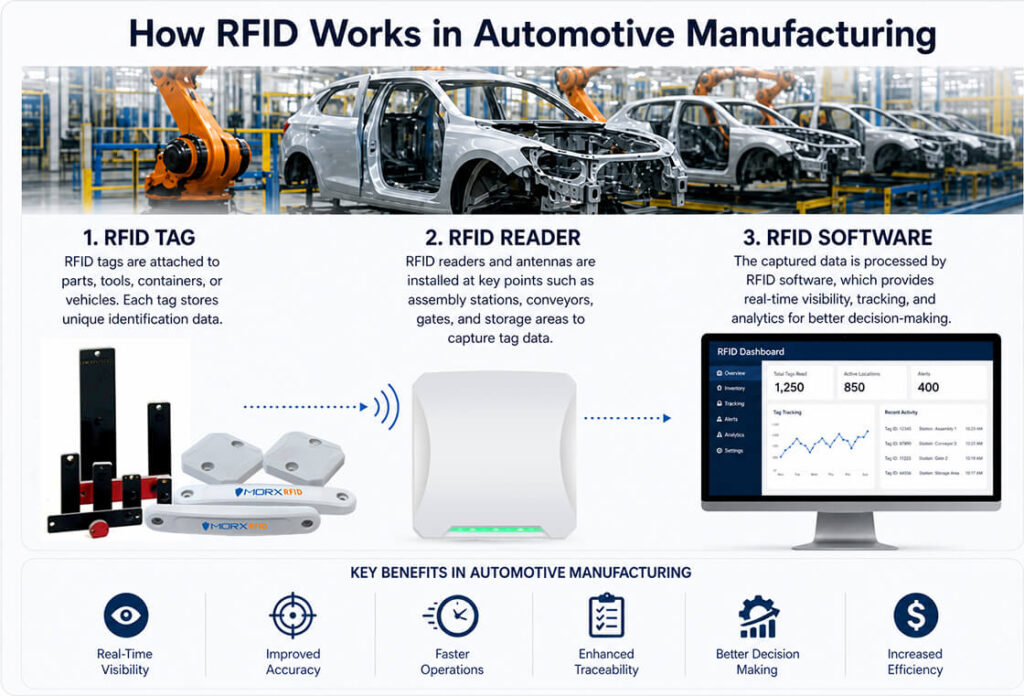
An RFID system generally consists of three key elements.
RFID tags are attached to or embedded in components, tools, containers, or vehicles, storing unique identification data.
RFID readers, along with antennas, are positioned at critical points such as assembly stations, conveyor systems, entry/exit gates, and storage areas to detect and capture tag information. This data is then processed by RFID software, which provides real-time insights, tracking, and analytics for better decision-making.
Compared to traditional barcode systems, RFID offers significant advantages. It does not require direct line-of-sight for scanning and can read multiple tags at the same time. These capabilities make RFID highly effective for fast-paced, large-scale automotive manufacturing environments where efficiency, accuracy, and automation are essential.
Why Automotive Manufacturers Are Using RFID
• Real-Time Visibility
RFID provides instant tracking of parts, tools, and vehicles across the production line and supply chain.
• Improved Inventory Management
Helps maintain accurate stock levels and supports just-in-time (JIT) manufacturing, reducing excess inventory.
• Enhanced Traceability
Enables manufacturers to track each component’s history, which is critical for quality control and recalls.
• Reduced Human Errors
Automation minimises manual data entry and scanning mistakes compared to traditional barcode systems.
• Faster Production Processes
RFID can scan multiple items simultaneously without line-of-sight, speeding up operations.
• Better Asset Utilisation
Tracks tools, equipment, and returnable containers to prevent loss and improve usage efficiency.
• Streamlined Supply Chain Operations
Improves coordination between suppliers, warehouses, and production units.
• Increased Accuracy in Assembly
Ensures the right parts are used at the right stage, reducing rework and defects.
• Labour Cost Reduction
Automation reduces the need for manual tracking and monitoring.
• Data-Driven Decision Making
Provides real-time data and analytics to optimise processes and improve productivity.
Key RFID Applications in Automotive Manufacturing
RFID technology works by using three main components: RFID tags, RFID readers, and software systems. RFID tags are attached to parts, tools, or vehicles and store unique identification data. RFID readers capture this data through radio signals without requiring direct line-of-sight. The collected data is then processed by RFID software, which provides real-time visibility, tracking, and analytics. This seamless data flow enables automotive manufacturers to monitor operations efficiently and make informed decisions across production and logistics.
1. Parts and Component Tracking
RFID is widely used to track individual parts and components throughout the manufacturing process. Each item is tagged and monitored as it moves across different production stages. This ensures the right components are available at the right time, reducing delays and production errors. It also helps manufacturers maintain better control over inventory and minimise losses.
2. Work-in-Progress (WIP) Monitoring
RFID enables real-time tracking of work-in-progress items on the factory floor. Manufacturers can instantly see where each product is in the assembly line and identify bottlenecks. This improves production planning and helps maintain a smooth workflow across all stages. As a result, overall efficiency and throughput are significantly enhanced.
3. Tool and Asset Management
Managing tools and equipment is critical in automotive manufacturing, and RFID makes this process more efficient. Tools can be tagged and tracked to ensure they are available when needed and returned after use. This reduces the risk of loss or misplacement and improves utilisation. It also helps in maintaining proper maintenance schedules for critical assets.
4. Quality Control and Traceability
RFID plays a key role in ensuring product quality by providing complete traceability of components and processes. Manufacturers can track which parts were used, when, and in which vehicle. In case of defects or recalls, this data allows for quick identification and resolution. This improves compliance with industry standards and enhances customer trust.
5. Warehouse and Inventory Management
RFID simplifies inventory management by automating stock tracking in warehouses. It provides accurate, real-time data on inventory levels without manual counting. This helps reduce overstocking or stockouts and supports just-in-time inventory systems. Faster inventory checks also save time and reduce operational costs.
6. Vehicle Tracking and Yard Management
RFID is used to track finished vehicles within manufacturing plants and storage yards. It helps locate vehicles quickly, manage dispatch operations, and improve logistics efficiency. This reduces delays in shipping and ensures timely deliveries to dealers or customers. Overall, it enhances visibility and control over vehicle movement.
RFID vs. Barcode Tracking in Automotive Manufacturing
Feature
Scanning Method |
Line-of-Sight Required |
Multiple Item Reading |
Speed |
Data Storage |
Durability |
Cost |
RFID
Wireless (radio waves) |
No |
Can read many items at once |
Fast and automated |
Stores more data, can be updated |
Works in harsh environments |
Higher initial setup cost |
Barcode
Optical (laser/line-of-sight) |
Yes |
One item at a time |
Slower, manual scanning |
Limited data, read-only |
Can be damaged easily |
Lower initial cost |
Implementation Considerations and Best Practices
Successfully implementing RFID in automotive manufacturing requires careful planning and execution. Manufacturers should begin by clearly defining their objectives—whether it’s improving traceability, reducing inventory errors, or enhancing production efficiency. Choosing the right type of RFID tags and readers based on the environment (e.g., heat, metal surfaces, or moisture) is critical for reliable performance.
Integration with existing systems such as ERP or MES is another key factor, ensuring seamless data flow across operations. It is also important to conduct pilot testing before full-scale deployment to identify potential issues and optimise system configuration. Employee training plays a vital role in maximising the benefits of RFID, as staff must understand how to use and maintain the system effectively.
Additionally, regular system monitoring and maintenance help ensure long-term performance and accuracy. By following these best practices, automotive manufacturers can achieve smoother implementation and unlock the full potential of RFID technology.
Frequently Asked Questions About RFID in Automotive Manufacturing
1. What is RFID, and why is it important in automotive manufacturing?
RFID (Radio Frequency Identification) is a technology used to automatically identify and track parts, tools, and vehicles using radio waves. It is important because it provides real-time visibility, improves accuracy, and reduces manual work in complex manufacturing environments.
2. How is RFID better than barcode systems in automotive production?
RFID offers several advantages over barcodes, such as no need for line-of-sight scanning and the ability to read multiple items at once. This makes processes faster, more efficient, and less prone to human error, especially in high-volume production lines.
3. Where is RFID commonly used in automotive manufacturing?
RFID is used in various areas, including parts tracking, work-in-progress monitoring, inventory management, tool tracking, and vehicle yard management. It helps improve coordination across production and logistics operations.
4. Is RFID expensive to implement for manufacturers?
RFID is used in various areas, including parts tracking, work-in-progress monitoring, inventory management, tool tracking, and vehicle yard management. It helps improve coordination across production and logistics operations.
RFID as a Strategic Advantage for Automotive Manufacturers
RFID provides automotive manufacturers with a powerful competitive edge by enabling real-time visibility, improved accuracy, and streamlined operations. Enhancing traceability and reducing inefficiencies, it helps companies optimise production and respond quickly to market demands. Ultimately, RFID supports smarter decision-making and drives long-term operational excellence.
CategoryBlog