
0

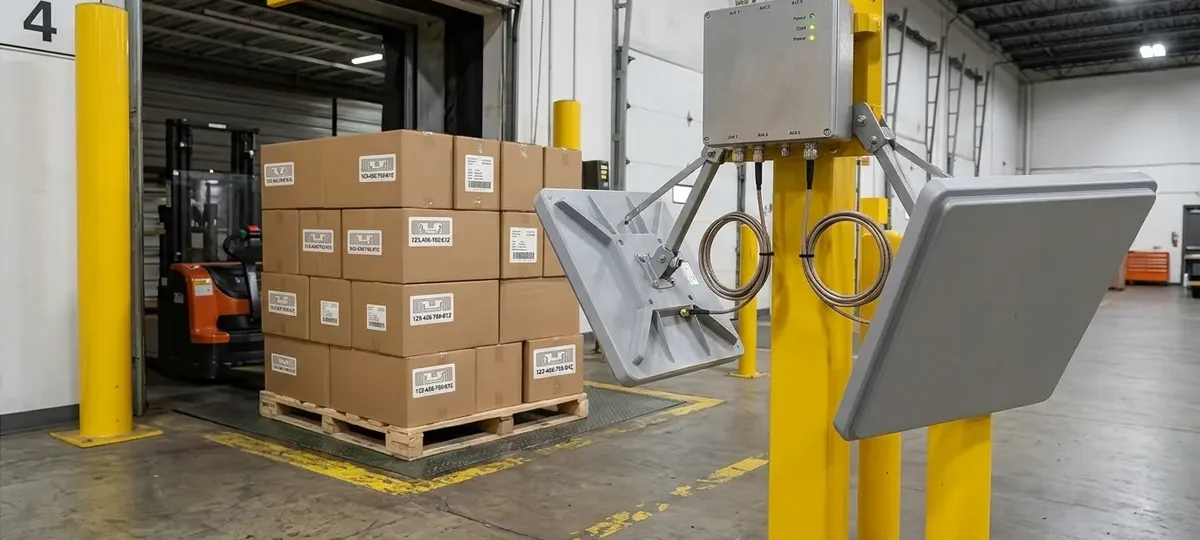
RFID Read Range Lower Than Expected? What Actually Affects It
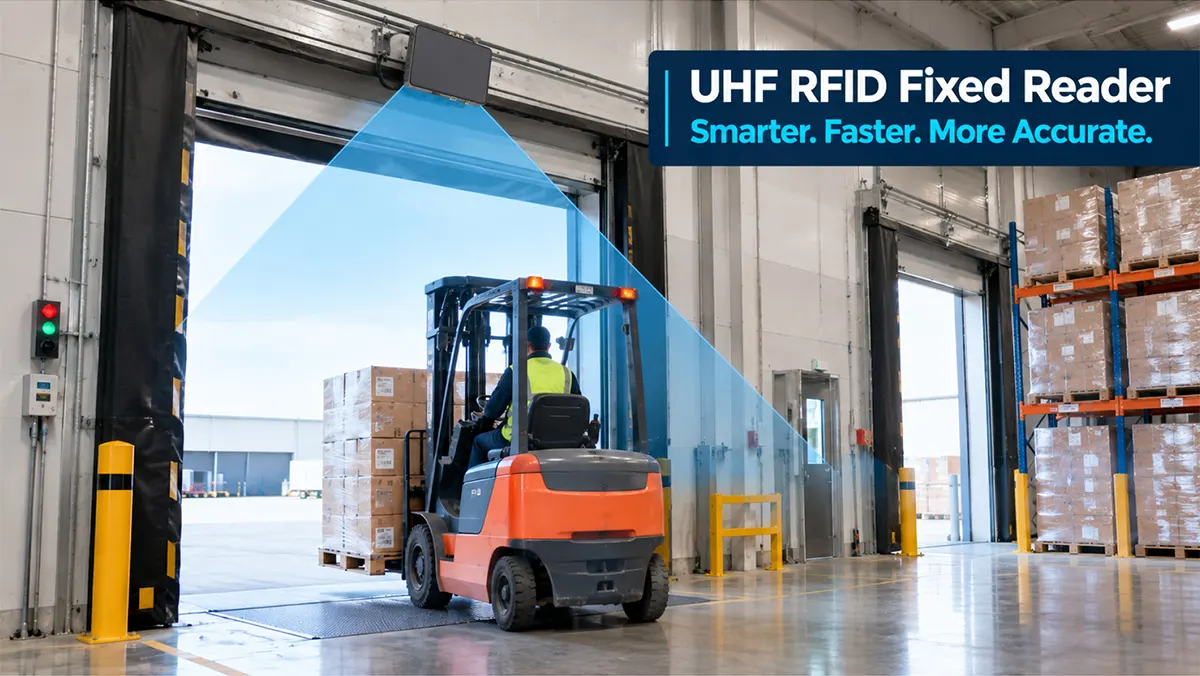
You installed your RFID reader, ran your first test, and the tags read fine at your desk. Then you mounted the same reader at the dock door or the gate, and suddenly it’s missing tags from four meters out, or only catching them when they’re held at a specific angle. If that sounds familiar, you’re not dealing with a defective reader – you’re dealing with read range, which is one of the most misunderstood numbers in RFID.
Most spec sheets quote a single read-range figure, as if it were a fixed property of the hardware. It isn’t. Read range is the outcome of several things working together – the reader, the antenna, the tag, and the environment – and changing any one of them changes the number you actually get on site. This article breaks down exactly what affects real-world read range, with figures from independent RFID testing rather than marketing claims, so you can set realistic expectations before you deploy.
What "read range" actually means
Read range is the maximum distance at which a reader can reliably detect a tag’s signal and decode its ID. For passive UHF tags – the type used in most warehouse, retail, and access-control deployments – range is typically measured in a few meters under open-air test conditions, and GS1’s own guidance notes that range can reach up to about 15 meters in special cases, with phased-array reader setups pushing toward 20 meters in controlled, high-sensitivity configurations. Those upper figures describe lab-grade setups, not a typical warehouse floor, which is exactly why real deployments so often fall short of the number on the box.
Tag performance also isn’t static industry-wide. The European EPC Competence Center’s annual UHF Tag Performance Survey – which benchmarked 108 UHF labels and 102 mount-on-metal tags across the 865–928 MHz bands used in Europe, North America, and Japan – recorded a roughly 20% year-over-year improvement in average tag read range, driven mainly by more sensitive chipsets. The takeaway for buyers: read range isn’t just a reader spec, it’s a reader-plus-tag outcome, and tag generation matters as much as reader model.
The five factors that actually move the number
1. Tag design and chip sensitivity
Not all passive tags are built the same. A compact label-style tag, a hard tag, and a mount-on-metal tag each use different antenna geometry and shielding, which changes how far they can be read and how they behave near interference. A newer, more sensitive chip can outperform an older tag design even when paired with the same reader – which is part of why the EECC survey above found average ranges climbing year over year independent of reader hardware.
2. Tag orientation relative to the antenna
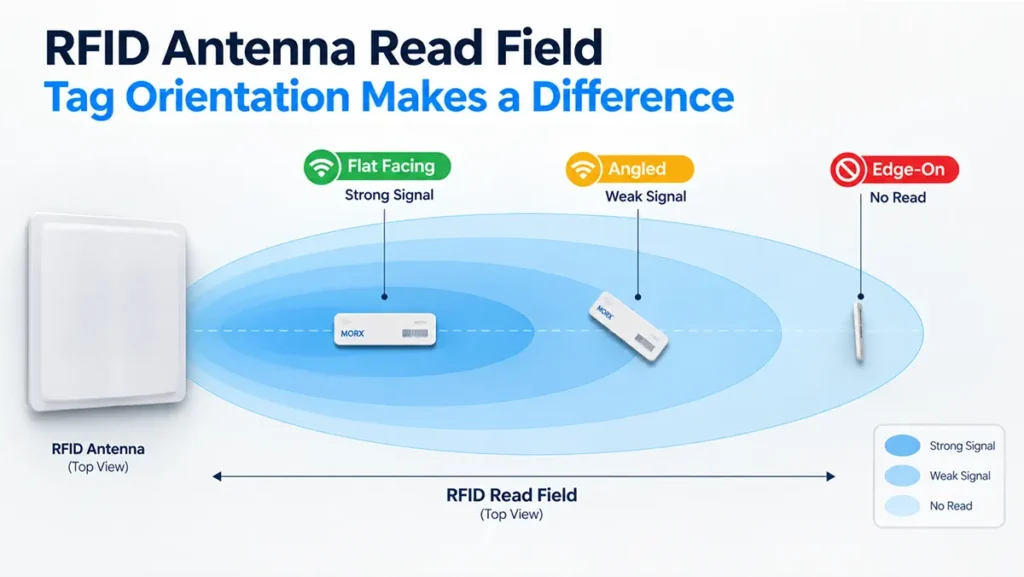
RFID uses polarized radio waves, and a tag’s antenna has to be reasonably aligned with the reader antenna’s polarization to read well. A tag held flat and square to the reader will generally read farther than the same tag turned edge-on or tumbled randomly on a conveyor. This is why pallets loaded inconsistently, or items tagged on inconsistent faces, often show patchy read results even though nothing about the hardware changed.
3. Metal and liquid in or near the read zone
Metal reflects and detunes UHF radio waves, and liquid absorbs them – both shrink effective range and can create dead zones or false negatives. This is precisely why mount-on-metal tags exist as a separate category: a standard label tag placed directly on a metal asset will almost always underperform its rated range, sometimes dramatically, because the metal surface interferes with the tag’s own antenna.
4. Reader power, antenna gain, and cabling
A reader’s transmit power and its antenna’s gain directly set the outer limit of the read field, but real installations lose some of that budget to cable length, connector quality, and antenna placement. A longer cable run between a fixed reader and an external antenna introduces signal loss that a spec sheet’s “maximum range” figure doesn’t account for, which is one reason two sites running the “same” reader model can see noticeably different results.
5. Site-level RF interference and read-zone density
Other readers operating nearby, metal racking, structural steel, and even densely packed tags competing for the same read window can all reduce effective range and consistency. In a high-density read zone – many tags clustered close together, like a stacked pallet – some tags read reliably while others are missed simply because of how the signal field interacts with that specific arrangement, not because any individual tag or reader underperforms.
A quick diagnostic checklist
If your read range is coming in lower than expected, work through these before assuming the hardware is at fault:
Running this checklist against a small, controlled pilot – one reader, one antenna, your actual tags, on your actual site – before a full rollout is still the most reliable way to know what range you’ll really get, because no published figure accounts for your specific combination of all five factors at once.
| Check | What to look at |
|---|---|
| Tag type | Is a standard label tag mounted directly on metal or near liquid? Switch to a mount-on-metal tag if so. |
| Orientation | Are tags facing the antenna consistently, or tumbled/angled inconsistently? |
| Cabling | How long is the run between reader and external antenna, and is the connector secure? |
| Antenna placement | Is the antenna aimed directly at the expected tag path, or is it catching tags at an angle? |
| Site interference | Is there metal racking, structural steel, or another reader nearby that could be detuning the field? |
| Read density | Are many tags clustered close together, competing for the same read window? |
| Tag generation | Is this an older tag design that may simply read shorter than a current-generation chip? |
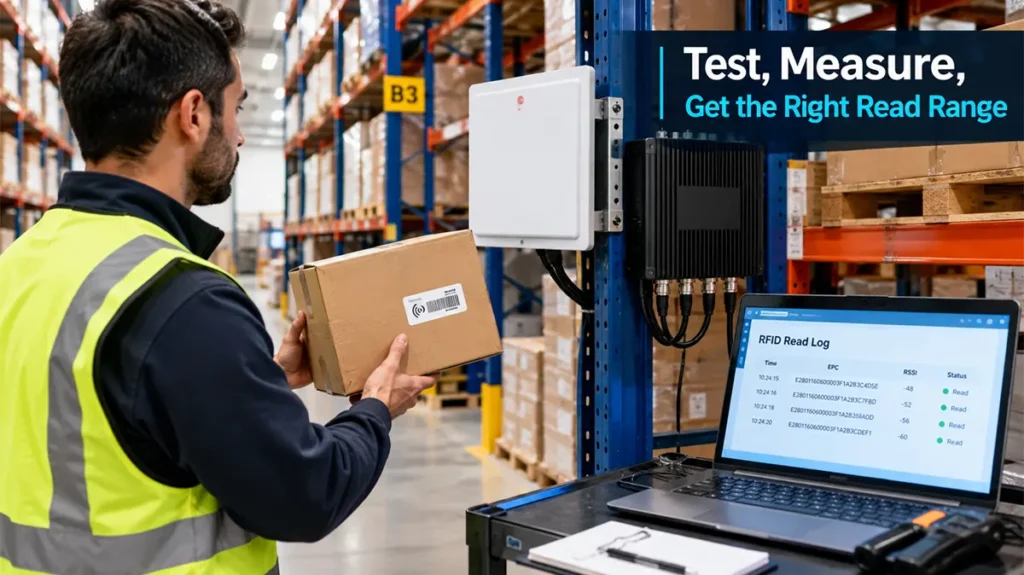
Matching the reader and antenna setup to your actual range needs
Once you know what’s realistically achievable for your tags and site, the next decision is hardware that matches that read zone rather than chasing the highest advertised number. For a single checkpoint like a gate or weighbridge, MORX’s integrated UHF readers combine the reader and antenna in one unit, which keeps cable loss out of the equation entirely since there’s no external antenna run to manage. For wider or multi-lane zones – a dock door, a conveyor line, or a setup you expect to scale – pairing a fixed reader with the right external antennas from RFID antenna gives you more control over gain, placement, and coverage than a single integrated unit can offer.
The bottom line
Read range isn’t a single number you can shop for – it’s the result of tag design, orientation, interference, cabling, and site conditions all acting together. Any published maximum describes a best-case lab test, not your floor. The practical path is to identify which of the five factors above applies to your deployment, test with your actual tags and site conditions, and choose a reader-and-antenna combination built for your specific read zone rather than the biggest number on a spec sheet.
If you want to walk through your site conditions and expected read zone with someone who can match equipment to your actual numbers, talk to MORX RFID about your deployment before you commit to a layout.
Frequently Asked Questions
Why is my RFID read range shorter than the spec sheet says?
Spec sheet figures are usually measured under open-air, lab-grade conditions with ideal tag orientation. Real deployments add cabling loss, metal or liquid interference, inconsistent tag orientation, and site-level RF noise – all of which reduce the practical range below the published maximum.
Does tag orientation really make that much difference?
Yes. Because UHF signals are polarized, a tag facing the antenna squarely will typically read farther and more reliably than one turned edge-on or tumbled randomly, even with identical hardware on both ends.
Will a standard RFID tag work on a metal surface?
Generally no, not well. Metal detunes and reflects the tag’s antenna signal, which is why mount-on-metal tags exist as a distinct product category built to counteract that interference.
Can I increase read range just by using a more powerful reader?
Partially. Reader power and antenna gain set the outer limit, but cabling loss, tag sensitivity, orientation, and site interference all cap the real-world result – a more powerful reader won’t fully offset a poorly placed antenna or a mismatched tag.
CategoryBlog