
0

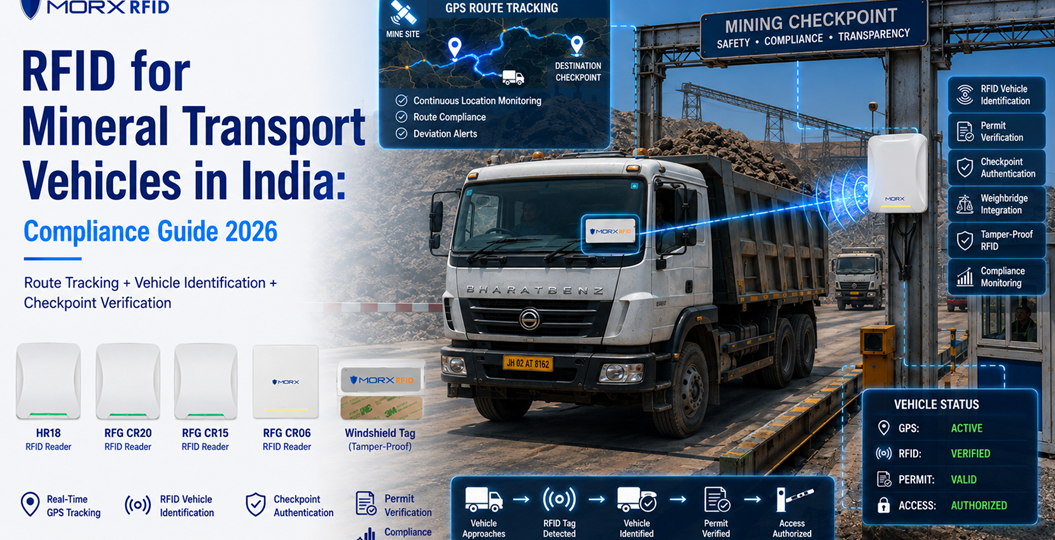
RFID for Mineral Transport Vehicles in India: Compliance Guide 2026
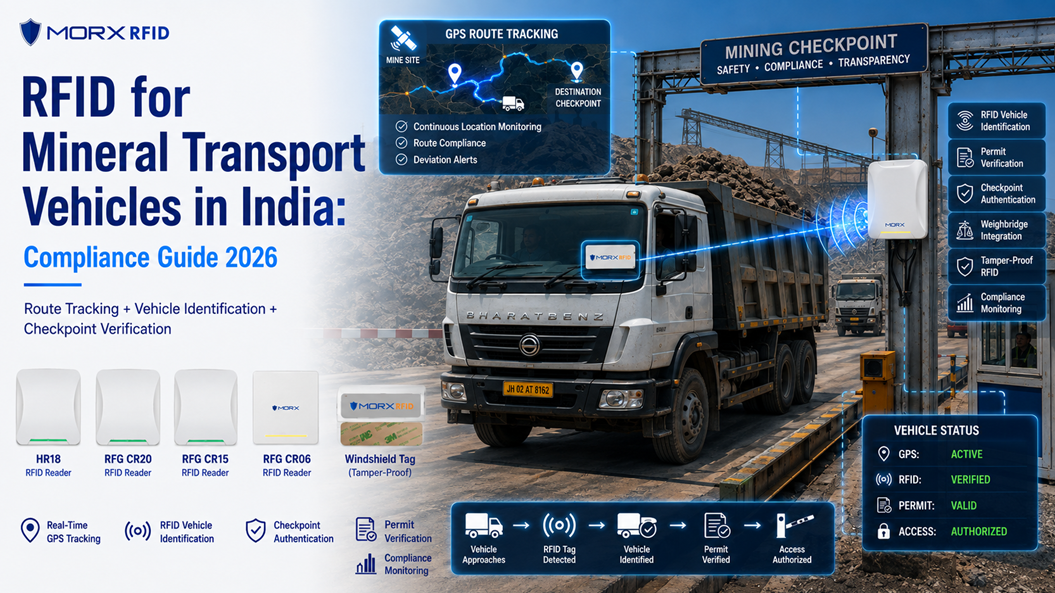
Mineral transport compliance in India has shifted fast over the past year. What used to be a patchwork of manual transit passes and weighbridge slips is being replaced, state by state, with mandatory GPS tracking and RFID-based vehicle identification — driven directly by state mining departments trying to shut down illegal extraction and undeclared transport. If you operate or supply vehicles for mineral haulage — sand, stone, marble, granite, coal, or iron ore — this is now a compliance requirement in a growing number of states, not an optional upgrade.
Why States Are Mandating GPS and RFID for Mineral Transport
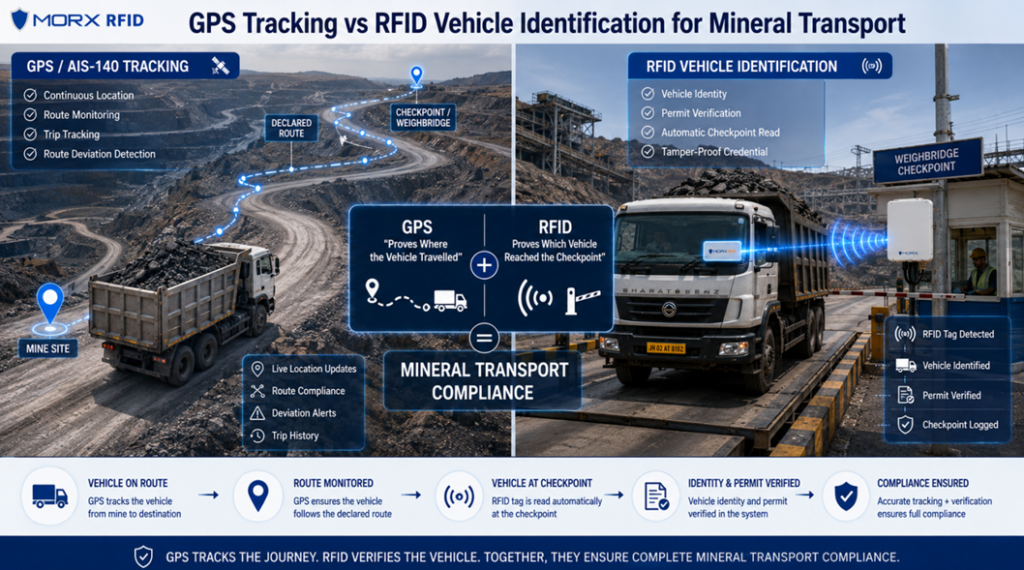
The push comes from a consistent problem across mining states: mineral trucks routinely deviate from declared routes, under-report loads at weighbridges, or move material without a valid permit altogether — all difficult to catch with manual checkpost inspection alone. GPS gives enforcement agencies continuous location data to catch route deviation; RFID gives checkposts and weighbridges a fast, automated way to confirm a specific vehicle’s identity and permit status without a manual paper check at every gate.
Jammu & Kashmir’s Integrated Mining Surveillance System, for example, combines GPS, RFID, e-Challan, and weighbridge data on one dashboard — and officials reported verifying 114 system-generated alerts that confirmed 14 illegal mining cases in a single enforcement cycle. That kind of detection rate is the reason this compliance model is spreading to other states.
The Two-Layer Compliance Stack: GPS Tracking vs RFID Identification
Mineral transport compliance frameworks in India generally combine two distinct technologies that solve different problems:
GPS / AIS-140 Tracking
An AIS-140 certified GPS device, installed in the vehicle, continuously reports location to the relevant state mining portal — confirming the vehicle stayed on its declared route between the mine and destination. This is a telematics device supplied and certified separately from RFID hardware, and is typically the first compliance requirement enforced by most states.
RFID Vehicle Identification
A tamper-proof RFID tag mounted on the vehicle’s windshield is read automatically at mine gates, weighbridges, and highway checkposts — instantly confirming the vehicle’s identity against its registered permit, without a manual document check slowing down the lane. This is where tamper-proof windshield tags and fixed RFID readers come in — they form the identification layer that GPS alone doesn’t provide at a fixed checkpoint.
Both layers work together: GPS proves the vehicle followed the correct route end-to-end; RFID proves the vehicle’s identity is verified at each fixed checkpoint along that route.
State-by-State Compliance Snapshot (2026)
Requirements vary by state and change frequently — always confirm current rules with your state mining department before deployment. Here’s the general landscape as reported across major mineral-producing states:
| State / UT | Portal / System | Framework | Status (as reported) |
|---|---|---|---|
| Jammu & Kashmir | IMSS (with BISAG-N) | Minor Mineral Concession Rules 2016, Rule 71 | GPS, RFID & e-Challan mandatory; Jan 26, 2026 deadline |
| Rajasthan | minesportal.rajasthan.gov.in / DMG OMS | VTS (GPS) onboarding requirement | All vehicles must be live on the portal by June 30, 2026 |
| Odisha | OMEPS / i4MS | AIS-140 GPS device mandate | Non-GPS vehicles treated as illegal transporters |
| Uttar Pradesh | MineMitra / UP VLTS | AIS-140 tracking, e-MM-11 permits | Cross-checked via Vahan portal |
| Madhya Pradesh | Mahakhani | State mining transport tracking | Active enforcement portal |
| Chhattisgarh | Khanij Online / e-Khanij | Mineral movement monitoring | Mandated vehicle tracking |
| Jharkhand | JIMMS | Transparent mineral movement tracking | State-mandated monitoring |
| Karnataka | ILMS | Illegal mining monitoring system | State-mandated tracking |
| Haryana | e-Ravana | Transit pass / rawana system | Active enforcement against non-compliant vehicles |
Where RFID Fits at the Mine Gate and Checkpost
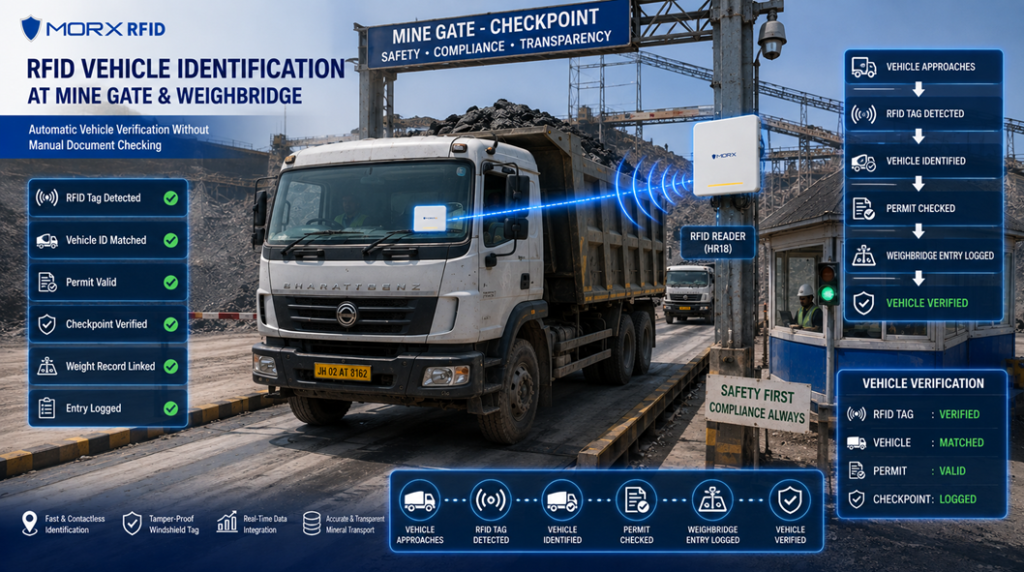
At a mine gate, weighbridge, or highway checkpost, the RFID layer typically works like this: a Windshield Tag — tamper-evident from all sides so it can’t be moved to an unauthorised vehicle — is mounted on each registered mineral transport vehicle. As the vehicle approaches the gate or weighbridge lane, a fixed RFID reader captures the tag automatically, without requiring the vehicle to stop for a manual document check, and logs the read against the vehicle’s registered permit in the state system.
This automated read matters for two reasons:
- Speed: High-volume mining checkposts process dozens of vehicles per hour; automated RFID reads remove the bottleneck of manual verification
- Tamper resistance: A transferable tag defeats the entire point of vehicle identification — tamper-proof construction ensures the tag can’t be moved to an unregistered vehicle
Choosing the Right RFID Reader for Mine Gates and Checkposts
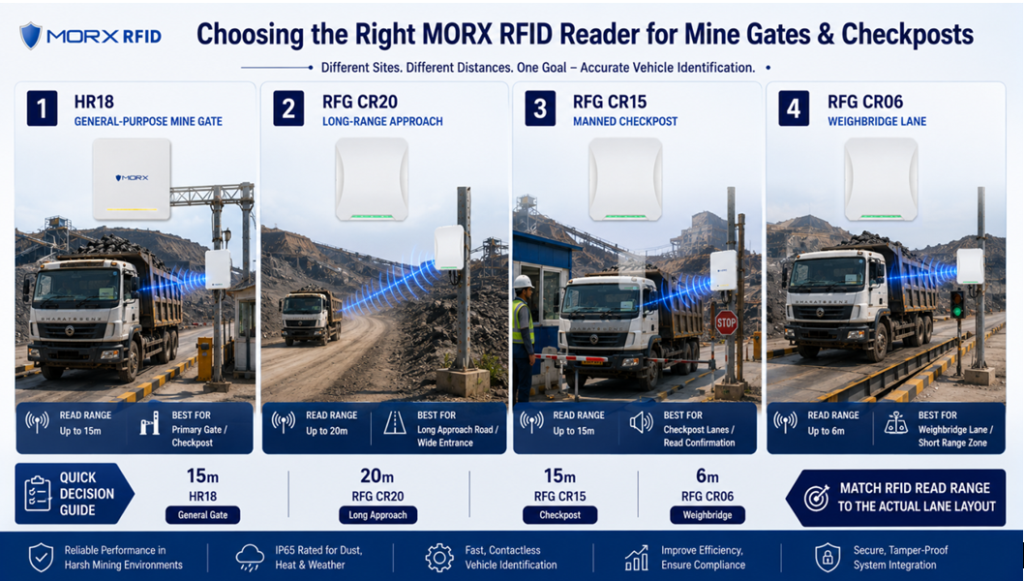
Reader selection depends on the physical layout of the checkpoint — lane width, approach distance, and how many lanes need coverage.
| Reader | Read Range | Antenna | Interfaces | Best For |
|---|---|---|---|---|
| HR18 | Up to 15m | Integrated, EPC Gen2 / ISO 18000-6C | TCP/IP, RS232, Wiegand | IP65-rated multi-purpose gate / checkpost reading |
| RFG CR20 | Up to 20m | 9dBi linear, built-in | RS232, WG26/34, TCP/IP, RS485 | Long approach roads, wide mine gate entrances |
| RFG CR15 | Up to 15m | 8dBi circular | RS232, WG26/34, RJ45, RS485 | Checkpost lanes needing buzzer/LED read confirmation |
| RFG CR06 | Up to 6m | 9dBi linear | RS232, WG26/34, TCP/IP, RS485 | Weighbridge lanes, controlled short-range checkpoints |
HR18 — General-Purpose Gate and Checkpost Reader
The HR18 reads up to 15 metres and supports TCP/IP, RS232, and Wiegand interfaces, with an IP65-rated build suited to outdoor mine gate installation. Its combination of vehicle identification and access control support makes it a practical default for a primary mine entrance.
RFG CR20 — Long-Range Approach Reading
The RFG CR20 extends read range to 20 metres with a built-in 9dBi linear antenna and adjustable RF power — useful where mine gates have a longer straight approach and vehicles need to be identified before they reach the barrier itself.
RFG CR15 — Checkpost Lane with Read Confirmation
The RFG CR15 covers 15 metres with an 8dBi circular antenna and includes a buzzer or LED recognition prompt — giving checkpost staff immediate confirmation that a tag was read successfully, which matters for manned checkposts running alongside the automated system.
RFG CR06 — Weighbridge and Controlled-Lane Reading
The RFG CR06 is built for shorter, controlled ranges — 6 metres — which suits weighbridge lanes where the vehicle is already moving slowly through a narrow, defined path and a wide read zone isn’t necessary.
All four are part of Morx’s UHF Integrated Reader range, supporting Wiegand and relay-based interfaces that integrate with existing checkpost barrier and boom gate hardware.
Typical Deployment at a Mine Gate or Checkpost
- Vehicle tagging: Every registered mineral transport vehicle is fitted with a tamper-proof windshield tag, encoded with a unique ID tied to its permit registration
- Approach reading: A long-range reader (CR20 or CR15) identifies the vehicle as it approaches the gate
- Weighbridge confirmation: A shorter-range reader (CR06) confirms identity again at the weighbridge lane, where load and permit are cross-checked
- Data logging: Each read is logged against the vehicle’s permit and GPS trip data on the relevant state mining portal
What to Verify Before Deployment
- Current state requirements: Confirm the exact GPS and RFID mandate, deadline, and portal for your specific state — these details change and vary significantly
- Tag tamper-resistance: Confirm the windshield tag cannot be transferred between vehicles, since that undermines the identification purpose entirely
- Read range for your lane layout: Match reader range to actual approach distance and lane width rather than defaulting to the longest-range option
- Integration with barrier hardware: Confirm the reader’s relay/Wiegand output is compatible with your existing gate or boom barrier system
Frequently Asked Questions
Do I need both GPS and RFID, or is one sufficient?
Most current state mandates require both. GPS confirms the vehicle followed its declared route continuously; RFID confirms vehicle identity at each fixed checkpoint. They serve different verification purposes and are generally treated as separate, complementary requirements rather than substitutes for each other.
Is the GPS/RFID mandate the same across all of India?
No — requirements, deadlines, and the specific portal vary by state. Jammu & Kashmir, Rajasthan, Odisha, Uttar Pradesh, Madhya Pradesh, Chhattisgarh, Jharkhand, Karnataka, and Haryana each run their own mining transport monitoring system with state-specific rules. Always confirm current requirements with your state’s mining or geology department directly.
Can a standard RFID tag be used, or does it need to be tamper-proof?
For mineral transport compliance specifically, tamper-proof or tamper-evident construction matters. A standard adhesive tag can be peeled off one vehicle and moved to another, which defeats the purpose of vehicle-level identification and creates a compliance and fraud risk.
What happens if a vehicle isn't GPS or RFID compliant?
Based on current enforcement patterns in states like Odisha and Rajasthan, non-compliant vehicles are typically treated as illegal transporters — leading to penalties, vehicle seizure, or transport restriction. Enforcement teams are increasingly using automated alerts from these systems rather than relying solely on manual checkpost inspection.
Conclusion
GPS and RFID compliance for mineral transport is moving from a pilot programme to a standard operating requirement across most major mining states in India. The GPS layer proves the route; the RFID layer proves the vehicle. Getting the RFID side right — tamper-proof tags, correctly ranged readers at each checkpoint type — is what makes the identification component actually work at the speed a busy mine gate or weighbridge needs.
Explore Morx RFID’s Windshield Tags and UHF Integrated Reader range — including the HR18, CR20, CR15, and CR06 — or visit the Solutions page to see how RFID vehicle identification applies across traffic and toll infrastructure. Contact the Morx RFID team for a checkpost-specific hardware recommendation.
This guide reflects publicly reported state mining department requirements as of 2026 and is intended as a general overview, not legal advice. Regulations and deadlines vary by state and change over time — confirm current requirements with your state mining or geology department before deployment.
CategoryBlog