
0

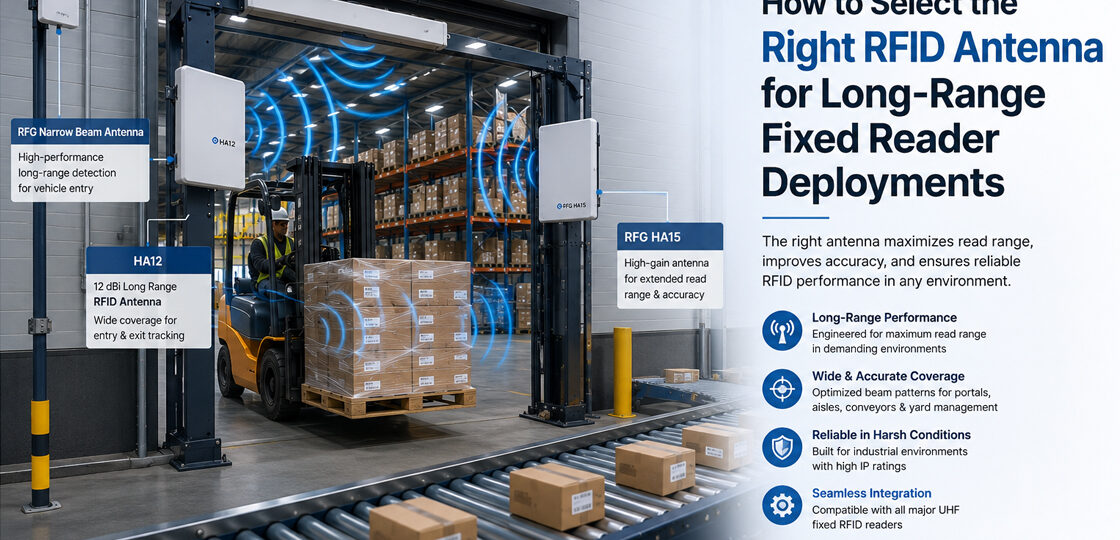
How to Select the Right RFID Antenna for Long-Range Fixed Reader Deployments
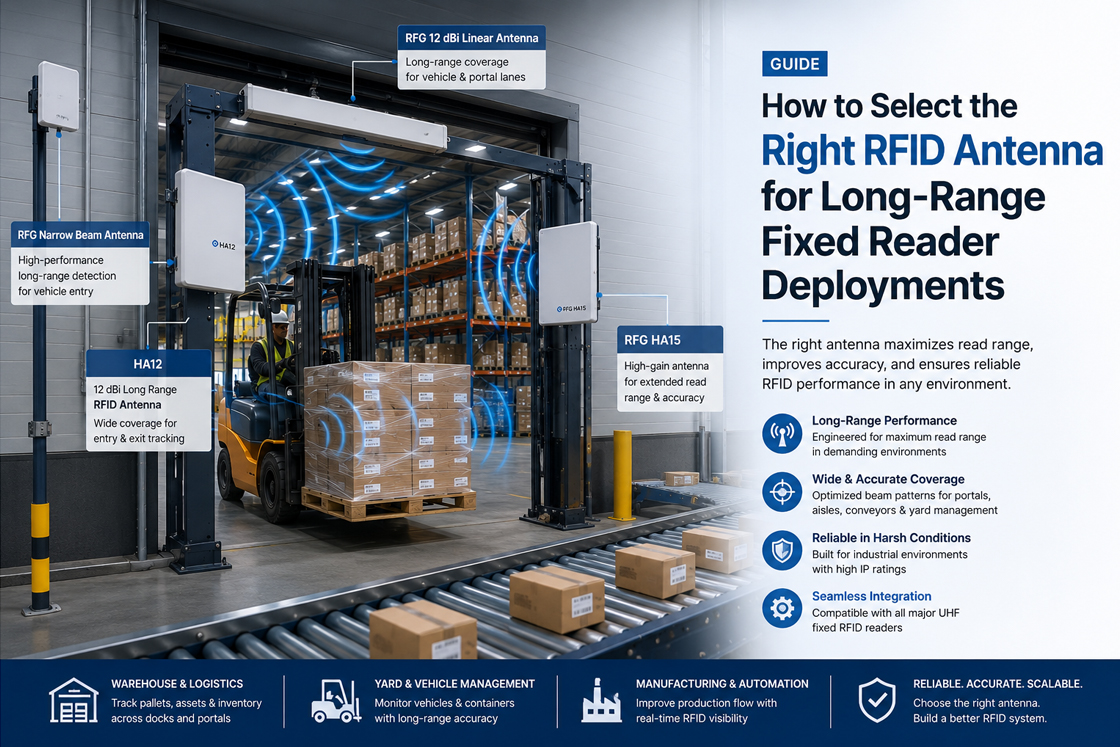
How to Select the Right RFID Antenna for Long-Range Fixed Reader Deployments
Most RFID system failures are not caused by the reader — they are caused by the wrong antenna. The antenna determines how far your system reads, how accurately it covers a zone, and how reliably it performs in real-world conditions.
If you are planning a gate, portal, warehouse, or conveyor deployment using a fixed RFID reader, selecting the right RFID Antenna is as important as the reader itself. This guide walks you through every factor that matters.
What Does the RFID Antenna Actually Do?
In a fixed UHF RFID system, the reader is the brain and the antenna is the reach. The reader generates the RF signal and processes the tag response — but it’s the antenna that radiates that signal into the environment and captures the reply from tags.
A single fixed RFID reader typically supports multiple antenna ports (usually 4 to 8), letting you cover multiple read zones with one device. The antenna you choose for each port defines the coverage shape, read range, and tag detection accuracy for that zone.
Factor 1 — Antenna Gain (dBi)
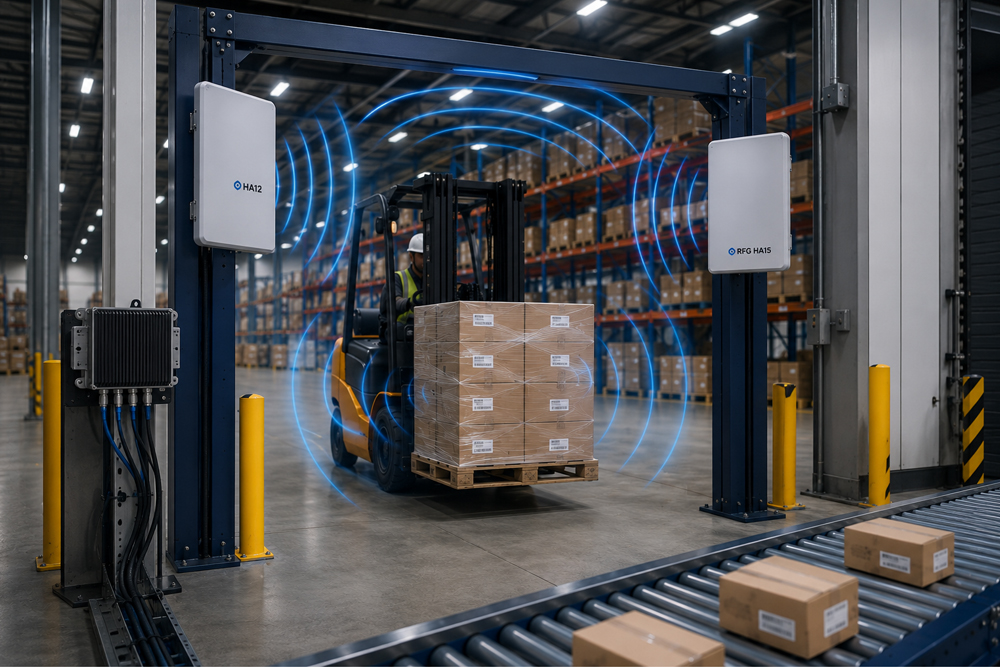
Antenna gain, measured in dBi, determines how focused or spread the RF energy is. Higher gain concentrates the signal into a narrower beam, which increases read range in that direction but reduces the coverage angle.
- 6–8 dBi: Wide-angle coverage for portals, dock doors, and shelving zones
- 9–12 dBi: Medium-range directional use for conveyor checkpoints and access lanes
- 12+ dBi: Long-range narrow-beam for vehicle gates, tolling, and corridor tracking
For most warehouse and manufacturing deployments, 8–9 dBi antennas paired with a multi-port fixed RFID reader deliver the best balance of range and zone coverage.
Factor 2 — Circular vs Linear Polarisation
Polarisation describes the orientation of the electromagnetic wave the antenna transmits. This single factor has the biggest practical impact on read reliability.
For most industrial deployments — warehouses, portals, conveyors — circular polarisation is recommended because tag orientation is rarely controlled. For high-speed vehicle identification at gates and toll stations, linear polarisation delivers superior range.
| Type | Circular Polarisation | Circular Polarisation |
|---|---|---|
| Signal Pattern | Rotates in all directions | Transmits in one plane |
| Tag Orientation | Works regardless of tag angle | Tag must align with antenna plane |
| Read Range | Slightly shorter | Longer — up to 80m (active) |
| Best For | Conveyor belts, portals, warehouses | Vehicle gates, tolling, long corridors |
| Signal Loss | 3 dB vs linear | Maximum gain in one direction |
Factor 3 — Read Range Requirements
Read range is not just about the antenna — it is a system result determined by antenna gain, reader output power, cable length, tag type, and environment. That said, antenna selection is the primary lever.
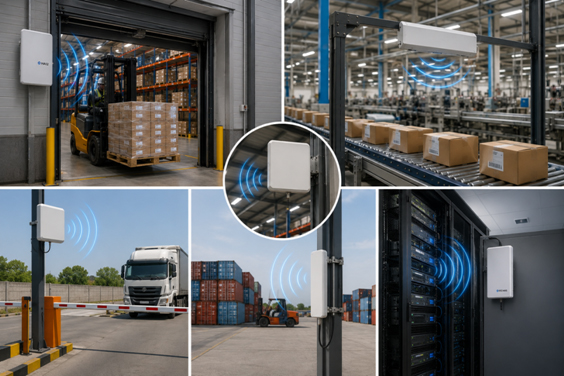
- Short range (up to 2m): Dock door verification, desktop encoding stations
- Medium range (2–6m): Conveyor belts, shelf portals, indoor access control
- Long range (6–15m): Warehouse gates, loading bays, yard management
- Ultra-long range (15–80m): Vehicle tracking, open-yard, active RFID systems
For passive UHF deployments using RFID Hard Tags or On-Metal RFID Labels, practical read range is typically 2–10m. For extended ranges beyond that, active tag systems are required.
Factor 4 — IP Rating and Environmental Durability
An outdoor antenna installed at a vehicle gate or loading dock is exposed to rain, dust, humidity, UV, and temperature extremes. Choosing an antenna without the right IP rating leads to signal degradation and early failure.
- IP54: Suitable for sheltered indoor environments with occasional dust
- IP65: Protected against water jets — standard for most outdoor installations
- IP67: Submersion-rated — required for harsh outdoor or washdown environments
Morx RFID Antennas are built for demanding industrial and enterprise environments, with stable RF performance even in conditions with metal interference and continuous operation requirements.
Factor 5 — Mounting Position and Coverage Shape
How and where you mount the antenna determines the coverage pattern as much as the antenna spec itself. Common mounting configurations:
- Overhead mount (ceiling): Wide downward coverage — ideal for conveyor lines and packing stations
- Side mount (wall/post): Horizontal beam for dock doors, gate portals, and aisle ends
- Portal mount (two antennas facing each other): Maximum read reliability for tagged items passing through
- Vehicle-level mount (low pole): Aimed at windscreen tags for parking and toll gate automation
Portal configurations with two or four antennas connected to a single fixed RFID reader are the most reliable setup for detecting every tagged item passing through a checkpoint, regardless of item orientation.
Factor 6 — Cable Length and Signal Loss
Every metre of coaxial cable between the reader and antenna introduces signal loss (insertion loss). For long cable runs, this can significantly reduce effective read range.
- Standard LMR-195 cable: ~0.66 dB loss per metre at 915 MHz
- LMR-400 (low-loss): ~0.22 dB loss per metre — recommended for runs over 5m
- Keep cable runs under 10m where possible with standard coax
- For runs over 15m, use a low-loss cable or relocate the reader closer to the antenna
This is an often-overlooked factor in deployments. A high-gain antenna connected via a long, low-quality cable will consistently underperform a moderate-gain antenna on a short quality run.
Quick Reference — Antenna Selection by Application
Use the following as a starting point when specifying antennas for common RFID deployment scenarios:
- Warehouse dock door: 8–9 dBi circular polarisation, IP65, side-mount portal
- Manufacturing conveyor: 6–8 dBi circular polarisation, overhead mount, short cable run
- Vehicle entry gate: 9–12 dBi linear polarisation, IP65/67, pole-mount at vehicle height
- Open yard / long corridor: 12+ dBi linear polarisation, directional, IP67
- Indoor IT / library asset tracking: 6 dBi circular polarisation, ceiling or wall mount
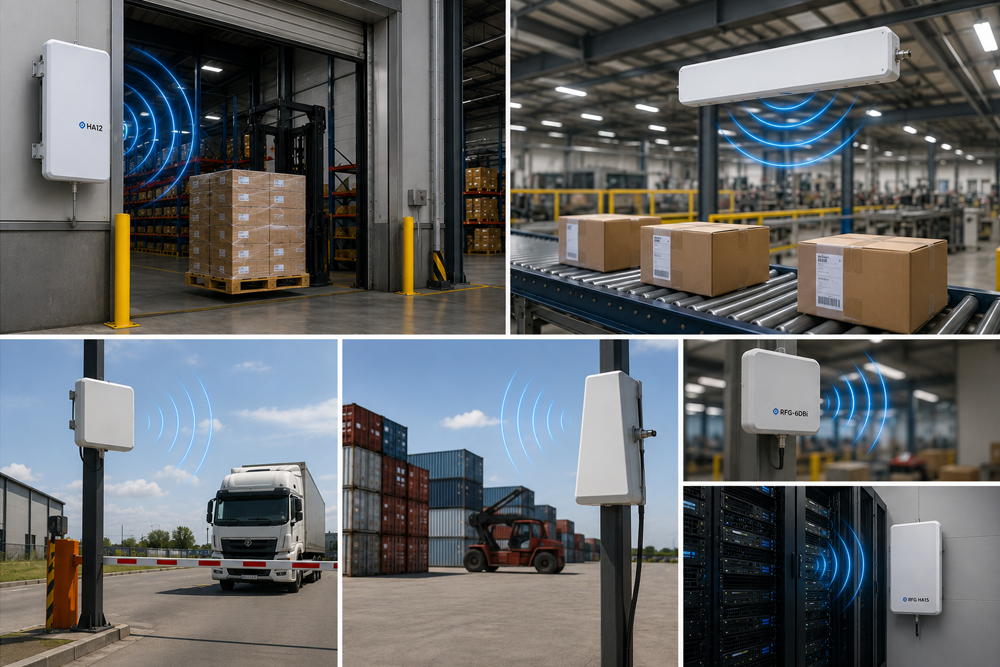
For applications like smart parking, traffic management, and warehouse management, the antenna specification changes based on lane width, vehicle speed, and required read distance. Always validate with a site survey before finalising the antenna model.
Always Validate the Reader-Antenna Combination
An antenna does not operate in isolation. Its performance depends on the reader it is paired with. Morx Fixed RFID Readers support external antenna connectivity and multiple antenna ports, making them compatible with the full Morx antenna range for gate, portal, and zone-based deployments.
If you are also evaluating reader types, refer to our earlier guide: How to Choose the Right UHF RFID Reader for Industrial Applications. It covers output power, multi-antenna port support, and integration requirements that directly impact antenna selection.
For field audits and inventory operations where a fixed installation is not required, Handheld RFID Readers with built-in antennas are the practical alternative to a fixed reader-antenna setup.
Conclusion
Selecting the right RFID antenna is not a secondary decision — it is the foundation of read performance in any fixed deployment. Match gain to range requirement, choose polarisation based on tag orientation control, verify IP rating for your environment, and keep cable runs short.
Explore the full range of RFID Antennas at Morx RFID, or visit our Solutions page to see how antenna configurations are applied across industries. For application-specific guidance, contact the Morx RFID team directly.
CategoryBlog