
0

RFID Intelligent Traffic Management System in India
Vehicular traffic control at road crossings has always been a concern for administrations in modern cities. Most present-day systems use pre-determined timing circuits to operate traffic signals, which are inefficient because they do not respond to the actual volume of traffic at a crossing. Vehicles wait at red lights even when there is no traffic in the other direction. Ambulances get delayed. Congestion builds — resulting in lost time, missed productivity, delivery delays, and increased costs.
Sensor-based systems were proposed to improve on fixed-timing controls, but their performance was limited by the need for direct line-of-sight between sensor and vehicle, and simultaneous multiple detections were difficult to handle. RFID solves all of these problems.
How RFID Intelligent Traffic Management Works
An Intelligent Traffic Control System using Radio Frequency Identification proposes RFID tracking of vehicles as the core principle. A high-speed RFID tag operating in the 865-868 MHz India frequency band — designed for nationwide road toll collection — is fitted to each vehicle. These tags are specifically designed for fast-moving objects at speeds of 40 to 80 km/hr and can be monitored at read distances of 40 to 70 kmph using currently available hardware.
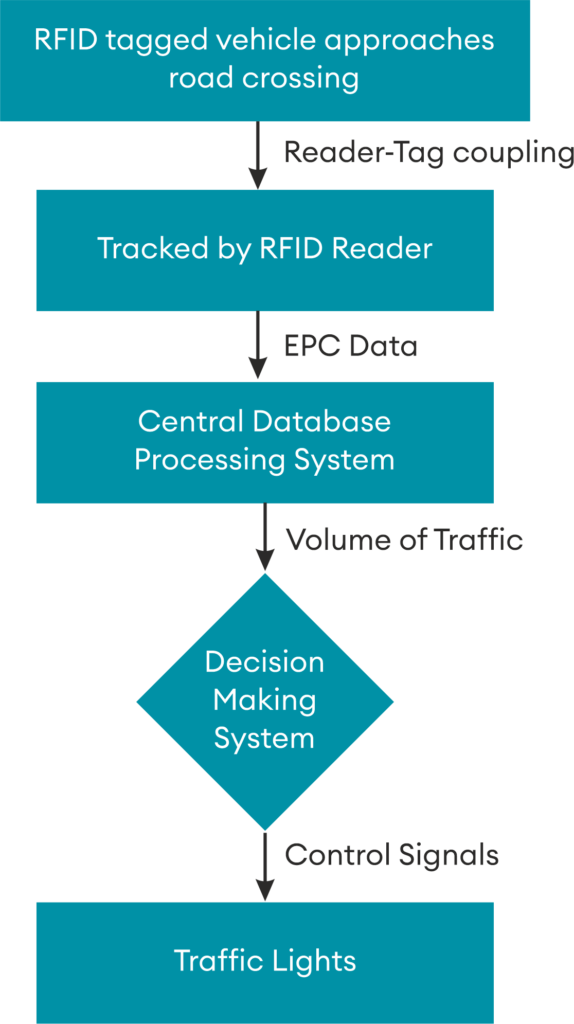
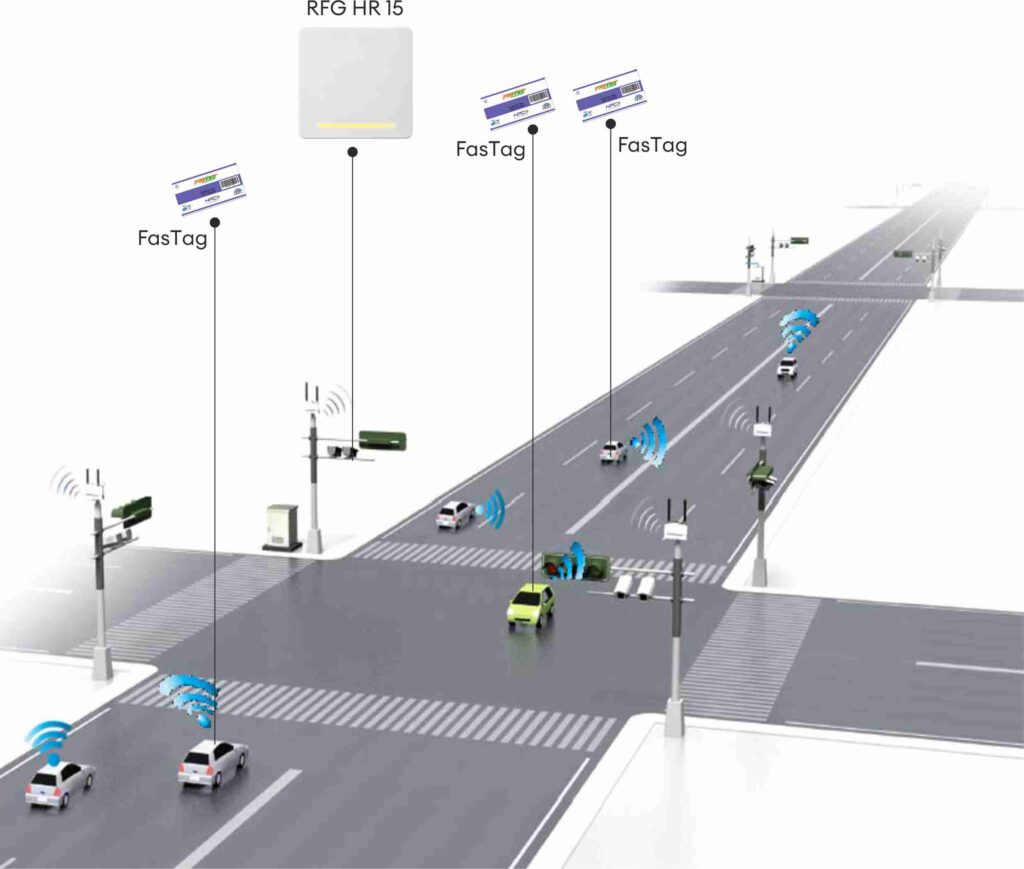
All FasTags on vehicles are read by RFID readers at intersections. The EPC data collected comes to the Central Monitoring System, which retrieves the complete details of each vehicle.

The system is comprised of two RFID readers per direction at each road crossing, connected to a Central Computer System that controls them all. As a vehicle passes a reader, it captures the vehicle’s Electronic Product Code — which contains the Vehicle Identification Number. Through a database lookup, the VIN is matched to individual vehicle records — retrieving type, weight, registration, pollution control status, and owner identification instantly.
The data is sent to the Central Computer System via wireless or wired channels. The Central Database Processing System processes vehicular data, and the Decision Making Section controls traffic signals in real time based on actual traffic volume — not a fixed timer.
This RFID Intelligent Traffic Control System delivers the following capabilities:
- Traffic signals operated according to the current volume of traffic at each crossing — not pre-set timers
- Differential priority assignment — ambulances, fire brigades, and VIP vehicles receive unrestricted passage; school and office rush hours adjust priority for cars and scooters; heavy vehicles receive higher priority at night
- Reportedly stolen vehicles or vehicles booked for offence can be tracked, and the time and direction of travel can be obtained
- E-Tolling of vehicles for any direction of travel, directly integrated with the FASTag system
- Reliable traffic data generated automatically for statistical analysis, planning, and smart city reporting
Applications and Benefits of RFID Traffic Management
RFID-based intelligent traffic management goes beyond signal control. The same infrastructure delivers value across vehicle tracking, law enforcement, tolling, and urban planning.
- Real-time vehicle identification at intersections and checkpoints using FasTag-compatible RFID technology
- Traffic flow optimisation driven by live volume data — reducing congestion without infrastructure expansion
- Integration with FASTag ETC tolling systems for seamless multi-lane electronic toll collection
- Detection and flagging of stolen or offence-registered vehicles in real time across all monitored crossings
- Statistical traffic data collection for municipal planning, road widening decisions, and smart city infrastructure
- Emergency vehicle priority routing — reducing response times for ambulances and fire brigades automatically
The same RFID hardware used for traffic management can extend to smart parking management and campus vehicle access control on a unified platform.
The system is comprised of two RFID readers per direction at each road crossing, connected to a Central Computer System that controls them all. As a vehicle passes a reader, it captures the vehicle’s Electronic Product Code — which contains the Vehicle Identification Number. Through a database lookup, the VIN is matched to individual vehicle records — retrieving type, weight, registration, pollution control status, and owner identification instantly.
The data is sent to the Central Computer System via wireless or wired channels. The Central Database Processing System processes vehicular data, and the Decision Making Section controls traffic signals in real time based on actual traffic volume — not a fixed timer.
Industries and Government Applications
Smart Cities — Real-time traffic intelligence for municipal corporations and urban development authorities implementing smart city infrastructure.
Highway Authorities — Automated vehicle monitoring, speed data collection, and e-tolling across national and state highway networks.
Municipal Corporations — Intersection management, traffic signal optimisation, and violation detection across city road networks.
Industrial Townships — Controlled vehicle access and movement tracking across manufacturing parks and industrial estates.
Toll Management Systems — FASTag-compatible e-tolling infrastructure for multi-lane, barrier-free toll collection.
Transportation Authorities — Fleet monitoring, overloaded vehicle detection, and statistical data collection for transport planning.
The following RFID hardware is used in Morx RFID intelligent traffic management deployments. Built for outdoor, high-speed vehicle identification applications in demanding road environments across India.
MORX HR15T A high-performance UHF RFID integrated reader built for high-speed vehicle identification and ETC applications. Designed to detect FasTag-equipped vehicles at speeds of up to 80 km/hr across road intersections, toll plazas, and access control points — delivering reliable reads in continuous outdoor operation.Lorem ipsum dolor sit amet, consectetur adipiscing elit. Ut elit tellus, luctus nec ullamcorper mattis, pulvinar dapibus leo.
Why Choose Morx RFID?
Morx RFID delivers end-to-end RFID traffic management solutions — hardware, software, integration, and support from one in-house team. Our systems are designed for Indian road and frequency standards, compatible with the national FASTag infrastructure, and deployable across urban intersections, highways, and industrial campuses.
With 1000+ RFID projects delivered across India and enterprise clients including Tata, Reliance, ONGC, and Adani Group, Morx RFID brings proven industrial-scale reliability to every smart infrastructure deployment. PAN India installation and post-deployment support is available nationwide.
Frequently Asked Questions About RFID in Automotive Manufacturing
1. What is RFID Intelligent Traffic Management?
It is a system that uses RFID tags on vehicles and readers at road crossings to detect vehicles in real time, control traffic signals based on actual traffic volume, and enable e-tolling and vehicle tracking — replacing inefficient fixed-timer signal systems.
2. How does RFID traffic monitoring work?
RFID readers installed at intersections detect FasTag-equipped vehicles as they pass. The system reads each vehicle’s EPC data, retrieves registration and identification details from the central database, and uses this data to control signals and generate traffic analytics automatically.
3. Can RFID track vehicle movement and identify offenders?
Yes. The system tracks the time and direction of travel for every detected vehicle. Stolen vehicles or those registered for offences are flagged automatically in real time when detected at any monitored crossing.
4. Can RFID integrate with FASTag and e-tolling systems?
Yes. Morx RFID’s traffic management hardware is fully compatible with India’s FASTag infrastructure and supports electronic toll collection for any direction of travel — making it suitable for toll plazas, highway checkpoints, and urban e-tolling applications.
5. Why choose Morx RFID for traffic management?
Morx RFID provides end-to-end hardware, integration, and support designed for Indian road standards. With 1000+ deployments and enterprise-level clients, we bring proven RFID reliability to every traffic and smart city infrastructure project.
Supportive Devices for RFID Intelligent Traffic Management
The following RFID device is used in MORX RFID Intelligent Traffic Management deployments across India. It enables accurate vehicle identification, RFID-based traffic monitoring, tolling automation, and smart transportation management. Designed for high-speed vehicle detection, the device supports reliable data collection, traffic analytics, and efficient traffic flow management across highways, smart cities, and transportation networks.
